
AN UPDATE FINALLY/AND NOTE TO STUDENTS WHO EMAIL ME FOR INTERVIEWS
I would like to apologize to regular visitors of this blog for not being able to update it as regularly as I had wanted to. I've been quite busy lately scanning originals and old komiks materials for the future home of this blog..which is PilipinoKomiks.com.
Yes, I have decided to expand this blogsite into a website so that it will be more comprehensive and more accessible. So I hope you will understand my silence for a while..
Anyway, during the last few months I received emails and invitations for talks, interviews by various organizations, students with thesis, as well as Channel 7 ( for their Bakekang series). From this time on, however, I am no longer accepting any of these requests for interviews.
I think it is because I felt used by Channel 7 production crews who interviewed me three times in one week two months ago. All the while I was made to believe that they were going to present a nationally televised presentation of Philippine komiks history, so I generously welcomed them to my home where they interviewed me about the history of komiks, and let me haul from my shelves my old komiks collections for them to shoot and photograph. My neighbors were alarmed why Channel 7 crews kept visiting my house and they thought that I'm already a celebrity...duh???
And then when the production was shown on Tv, not a significant portion on komiks history was included...all that was included was about Captain Barbell, and his new costumes etc..obviously geared to promoting their Captain Barbell series...And to think that they interviewed me close to two hours about komiks history...
I am not assuming that students will do such thing...but no I cannot accomodate all of you for interviews...So I am making it clear and simple..send no more emails asking for interviews as I will not answer them.
If you want to know something about the history of Philippine komiks, you can go to my previous posts in the archive section of this blog. Those articles are by no means complete of course, ..(hint you have to research further in libraries or just google them).. Plus you can also browse GerryAlanguilan's wonderful website Komikero.com, which offers a fascinating section on komiks history in his Philippine Komiks Art Museum, as well as his previous wonderful articles on komiks history.
I also recommend you to read the classic "History of Komiks in the Philippines and other Countries" by Cynthia Arevalo, et al, as it offers a fascinating, albeit biased, overview of the komiks tradition in the Philippines.
As for libraries...well, I don't know any library that has a wide selection of Tagalog komiks materials but you can try the Lopez Memorial Museum located in Benpres Buiding in Ortigas Avenue.. They have a large inventory of rare Philippine cartoons from 1800s to 1930s, as well as complete set of the Liwayway from the earliest issues to the 1950s. They may also have a few pieces of Ace komiks materials.
The National Library has two or three tomes of bookbound komiks but do not expect to find rare ones..as they have disappeared long time ago because librarians usually discard komiks tomes annually because they felt komiks have no "research value".
FOR PEOPLE ASKING FOR XEROX COPIES OF OLD KOMIKS
I also receive frequent emails regarding photocopying of old komiks. I'm sorry but I only entertain illustrators(or writers) or their families to xerox their or their relatives' works...So if you are an artist who want to search for your early works and they happen to exist in my collection..I can photocopy with only a minimum charge, i.e. xerox and paper expenses..
Monday, September 04, 2006


Thursday, August 24, 2006
Tony Velasquez: Photo Gallery 2
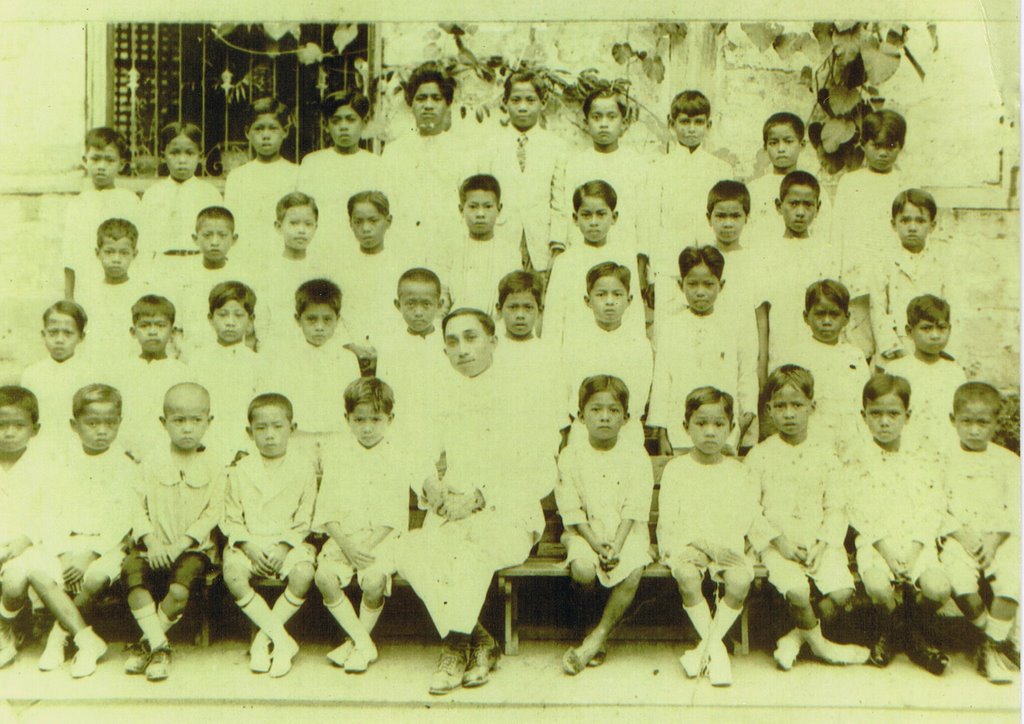 Class Portrait: Sta. Ana Elementary School 1917. Young Velasquez is third boy from left in the third row.
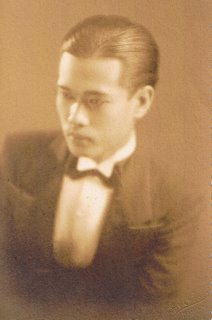 Studio Portrait 1929, around the time of the birth of Kenkoy
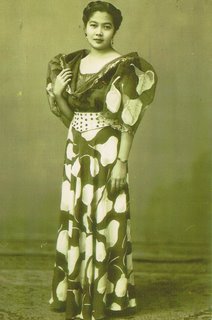 Ms. Pilar Tongco, the real-life Rosing of the Kenkoy Album, circa 1943
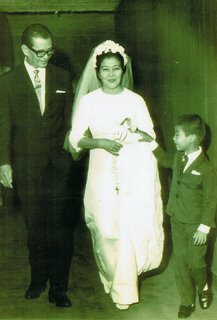 The long-awaited marriage finally happened in 1967
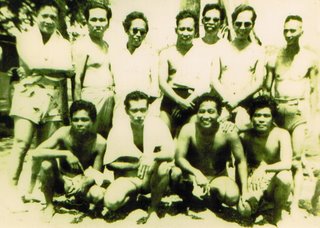 When they were kings...the kings of komiks in a rare photograph taken while on a beach holiday, circa 1958. Tony Velasquez is second from left, first row.
Monday, August 07, 2006
Tony Velasquez: Photo Gallery


Self-Portrait, 1946
 Acceptance Speech, Gawad CCP Grand Award for the Culture and Arts, 1993
Tony Velasquez(1910-1997), Educator, Editor, Publisher, Storyteller, Cartoonist, Illustrator, Poet, Essayist, Fine Artist, Founder of the Pilipino Komiks, and the recognized Father of The Tagalog Comics Magazines.

The last known portrait..celebrating his 86th birthday on October 29, 1996.
Wednesday, July 12, 2006
A Gallery of Philippine Original Cartoon Art
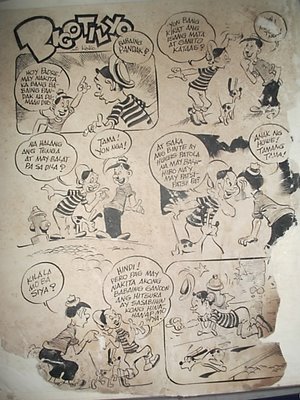 Bing Bigotilyo is Francisco V. Coching's first cartoon character. It first appeared in the Silahis Magazine in late 1930s, was censored during the Japanese occupation, and continued after the war. Although Coching was more well known for his serious comic art, which by the way influenced generations of Philippine comics artists, yet unknown to many, he started out his career as a cartoonist in the Silahis Magazine. His style of cartooning was different from the style of Tony Velasquez or Francisco Reyes, but more in the vein of style by Mauro Malang and Romeo Tabuena.
I happen to keep an extant, although badly damaged original of Bing Bigotilyo from the 1930s. Yet this in itself is a proof of Coching superior cartooning technique, as well as his hilarious sense of humor.
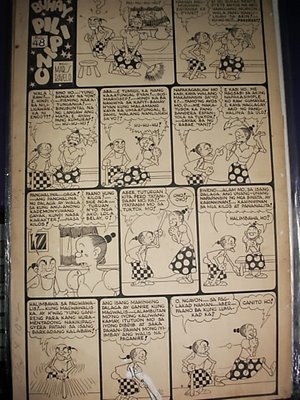
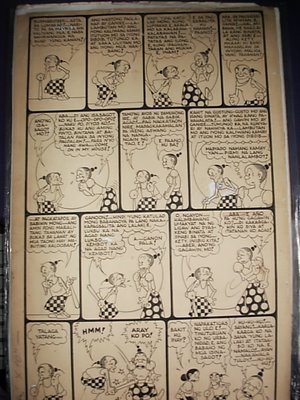 Mars Ravelo's BUHAY PILIPINO may well be the master's greatest work, and for a reason. It was Ravelo's most popular and enduring work. I really think that Ravelo was at the height of his writing prowess when he created Buhay Pilipino. It was more than a comic strip, it reflected the very life of the typical Filipino family of those golden years. More than any other cartoon strip, Ravelo manifested his deep knowledge of sociology and psychology in Buhay Pilipino.
 Even Ravelo's former critic, the veteran writer Clodualdo del Mundo, was forced to admit that "Buhay Pilipino" amused him. "Ravelo's writing is admirable, his Tagalog is deep, and he has a great sense of humor".. "Buhay Pilipino" satirized Philippine life during the 1940s and the 1950s. The older generation of Filipinos will never forget its immortal characters Tekla, Gorio, Lola Belay, the spinster Kety, and a whole lot of others that Ravelo added to its roster as it made its success through the hearts of the Filipinos. Quite simply put BUHAY PILIPINO is a tour de force. If you can find an old copy of the Liwayway containg this strip, you will see what I mean.
When Ravelo left the Liwayway to concentrate on his own comic publishing, he could not bring with him his Buhay Pilipino because of legal reasons. It was continued under different titles by other writers like Pat Justimbate (who was a student of Mars Ravelo) and Andres Cristobal Cruz. The above featured originals are the only two known extant originals of Buhay Pilipino from the 1951 series.
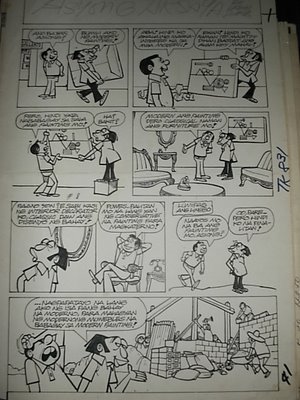 One of Larry Alcala's most famous cartoon characters, Asyong Aksaya dubuted in the Tagalog Komiks in the 1970s. It was later adapted into a movie starring Chiquito in the extravagant title role.
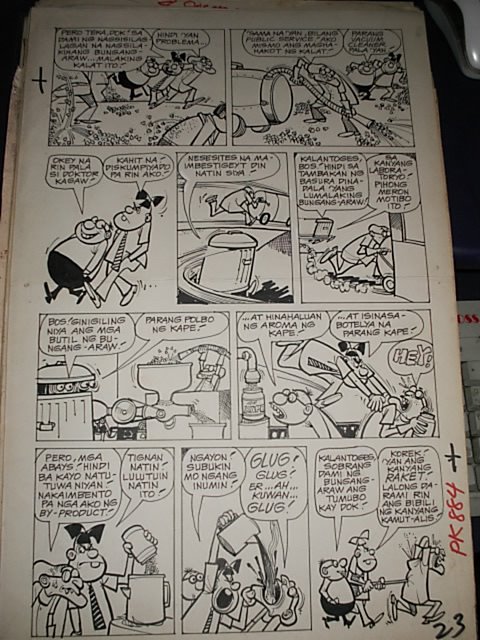 Perhaps no other duo in Philippine cartoon history is more memorable than Larry Alcala's Kalabog en Bosyo, who debuted in the Pilipino Komiks in 1947 under the original title ANG KALABOG and the now famous byline "Kalambogesyones ni Larry". Made into several movie adaptations, kalabog en Bosyo is our everyday fumbling detectives who solves the crimes.....accidentally. Other duos that have been partially influenced by Kalabog en Bosyo include Bert Sarile's Ping at Pong and Max en Jess.
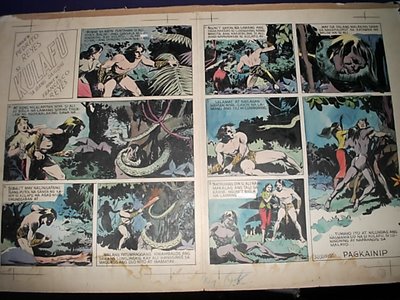 A contemporary of Tony Velasquez, Jose Zabala-Santos and J.M. Perez, Francisco Reyes great contribution to Philippine cartoon art is his immortal KULAFU. Of course, none of us younger geneartion living today will know that, because Kulafu existed only during the pre-war years of Philippine cartooning.
Influenced by Rice Borrough's Tarzan, Kulafu was the first ever cartoon strip to cover two whole pages of the Liwayway, and in full color! It was a very popular cartoon at that time, even competing with Kenkoy in terms of mass readership, yet after the war, Reyes surprisingly did not continue Kulafu, but instead created Talahib, another Tarzan-like character in the Halakhak Komiks. Yet despite his early demise, KULAFU will always be remembered as The Lord of the Philippine Jungles.
TO BE CONTINUED....
Monday, July 10, 2006
Kenkoy: The Beginnings
In the 1930s up to the 1960s Kenkoy entertained our lolos and lolas with his wit and humor, as well as his crazy antics, colonial mindset, and carabao english.
Wrote Tony Velasquez in his memoirs "It was all pure coincidence that I created Kenkoy in 1928. The original cartoonist assigned to create the character, Procopio Borromeo, was approached by writer Romualdo Ramos to start a series of cartoons for the Liwayway magazine. But Borromeo, busy with his other deadlines, could not come up with the character, so the job was given to me"
Where did Tony velasquez get his inspiration for Kenkoy's character?
"During those times (the 1920s), in our neighborhood in Paco, there was a group of ukelele-weilding young lads who called themselves Kalatog Pinggan. They would roam the streets up to the early morning hours, searching for wakes(lamayan), and beautiful girls to serenade(harana). They were quite naughty boys but they were all well-dressed in the style of the Jazz Age, what you would call today as "maporma". It was from them that I got the inspiration to create the character of Kenkoy".
So it is not true that Kenkoy was influenced by Walt Disney's Mickey Mouse?
"No, Kenkoy was not influenced by Mickey Mouse. Mickey Mouse and Kenkoy were born on the same year(1928), possibly Kenkoy was even older because I created him sometime in the mid of 1928, but the first issue did not come out until the January 11, 1929 issue of the Liwayway"
How much was he paid during his first years as cartoonist of Kenkoy?
"Romualdo Ramos (who wrote the earliest Kenkoy stories) and I received 20 pesos each for every issue of Kenkoy. And since Kenkoy appeared in the Liwayway four times a month, that means we have 80 pesos each every month..not bad for a beginner cartoonist like me, at a time when the daily wage was only one peso a day".
The first issue of the Kabalbalan ni Kenkoy consisted only of four frames. But later on, due to is success with the readers, the strip was expanded into six frames, and much later, half page. After three years, it already occupied a whole page of the Liwayway, with four colors to boot. A few years later, Kenkoy appeared in translation in all of the magazines of the Roceses including the Ilocano Bannawag, the Bicolano Bikolnon, and the Hiligaynon's Bisaya.
Thus Kenkoy was also the first character to transcend the language barrier of the Philippines, with his presence in some of the major dialects in the Philippines.
Unfortunately, after two years, Romualdo Ramos died, and Tony Velasquez was left to create the scripts as well. "Yet, I still gave the half of my earnings to Romualdo's widow for a full two years afterwards. It must be that way. Yan ang utang na loob, dapat lahat ng tao nakakaalam niyan".
 Kenkoy, the first Filipino cartoon character, with his creator Tony Velasquez (aged 19) in the background, the recognized Father of the Tagalog Comics. (This is actually an old Kenkoy figurine doll from the collection of Tony Velasquez, and I placed his vintage picture from 1929 as a background)
Wrote Tony Velasquez in his memoirs "It was all pure coincidence that I created Kenkoy in 1928. The original cartoonist assigned to create the character, Procopio Borromeo, was approached by writer Romualdo Ramos to start a series of cartoons for the Liwayway magazine. But Borromeo, busy with his other deadlines, could not come up with the character, so the job was given to me"
Where did Tony velasquez get his inspiration for Kenkoy's character?
"During those times (the 1920s), in our neighborhood in Paco, there was a group of ukelele-weilding young lads who called themselves Kalatog Pinggan. They would roam the streets up to the early morning hours, searching for wakes(lamayan), and beautiful girls to serenade(harana). They were quite naughty boys but they were all well-dressed in the style of the Jazz Age, what you would call today as "maporma". It was from them that I got the inspiration to create the character of Kenkoy".
So it is not true that Kenkoy was influenced by Walt Disney's Mickey Mouse?
"No, Kenkoy was not influenced by Mickey Mouse. Mickey Mouse and Kenkoy were born on the same year(1928), possibly Kenkoy was even older because I created him sometime in the mid of 1928, but the first issue did not come out until the January 11, 1929 issue of the Liwayway"
How much was he paid during his first years as cartoonist of Kenkoy?
"Romualdo Ramos (who wrote the earliest Kenkoy stories) and I received 20 pesos each for every issue of Kenkoy. And since Kenkoy appeared in the Liwayway four times a month, that means we have 80 pesos each every month..not bad for a beginner cartoonist like me, at a time when the daily wage was only one peso a day".
The first issue of the Kabalbalan ni Kenkoy consisted only of four frames. But later on, due to is success with the readers, the strip was expanded into six frames, and much later, half page. After three years, it already occupied a whole page of the Liwayway, with four colors to boot. A few years later, Kenkoy appeared in translation in all of the magazines of the Roceses including the Ilocano Bannawag, the Bicolano Bikolnon, and the Hiligaynon's Bisaya.
Thus Kenkoy was also the first character to transcend the language barrier of the Philippines, with his presence in some of the major dialects in the Philippines.
Unfortunately, after two years, Romualdo Ramos died, and Tony Velasquez was left to create the scripts as well. "Yet, I still gave the half of my earnings to Romualdo's widow for a full two years afterwards. It must be that way. Yan ang utang na loob, dapat lahat ng tao nakakaalam niyan".
Kenkoy, the first Filipino cartoon character, with his creator Tony Velasquez (aged 19) in the background, the recognized Father of the Tagalog Comics. (This is actually an old Kenkoy figurine doll from the collection of Tony Velasquez, and I placed his vintage picture from 1929 as a background)
Wednesday, July 05, 2006
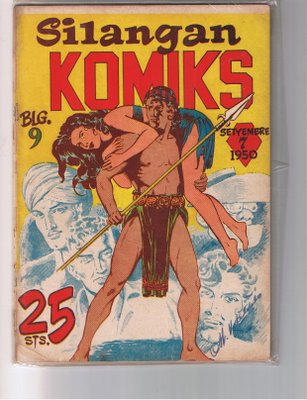
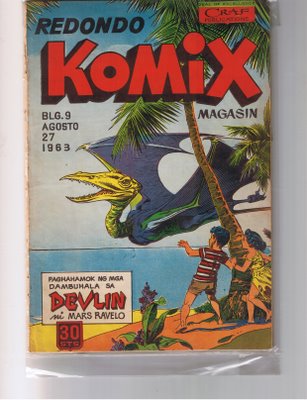
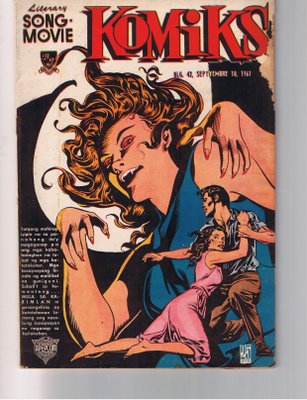
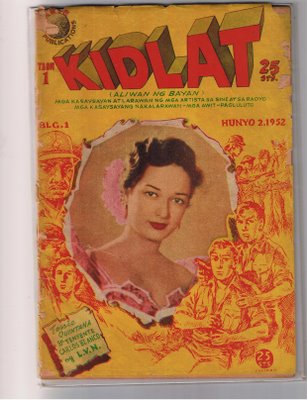
A Gallery of Rare Komiks
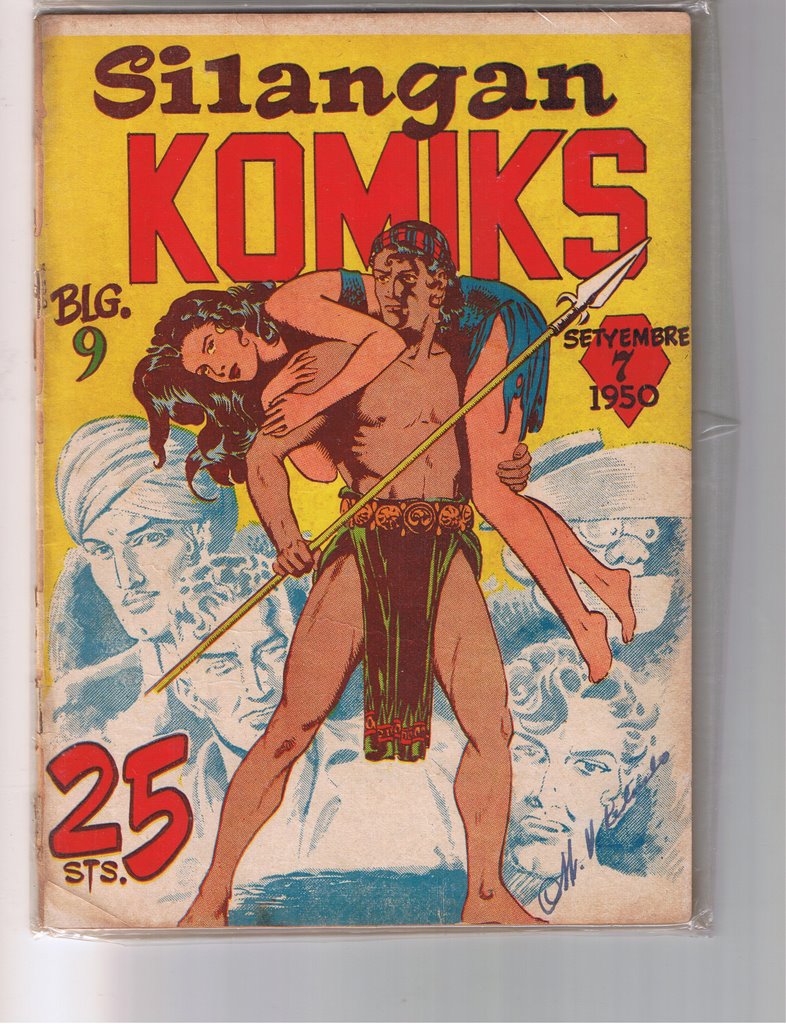
As an identification guide, I will regularly feature in this blog some of the rare pieces in my collection of Philippine comics.
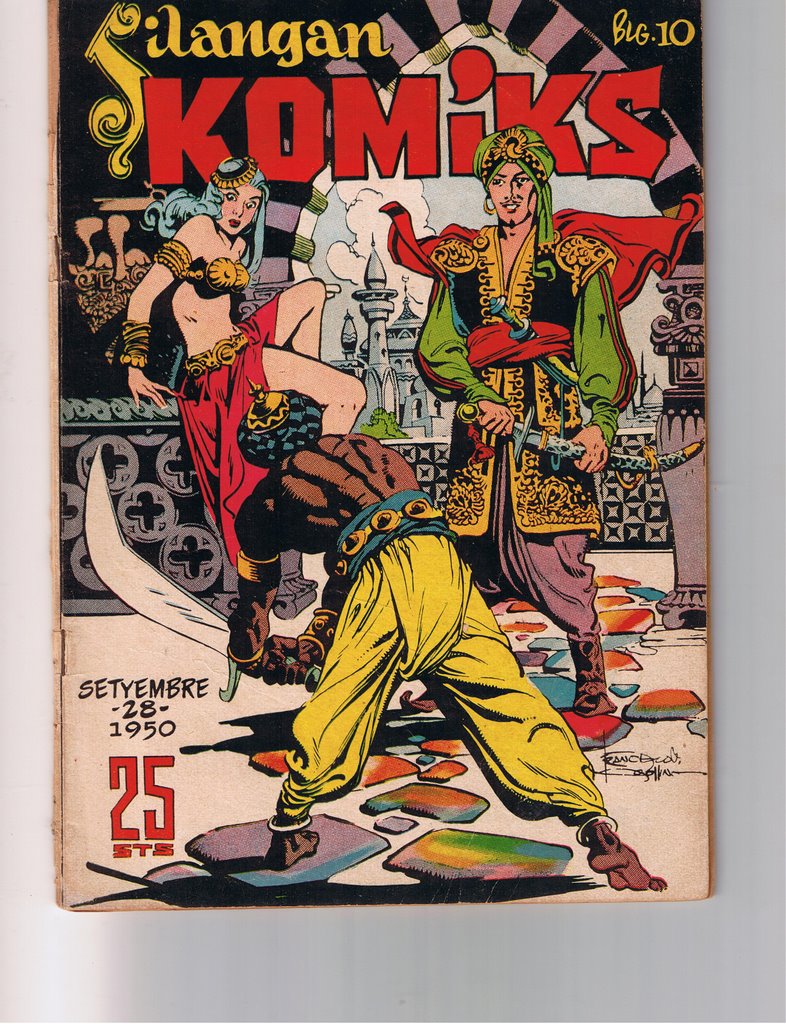
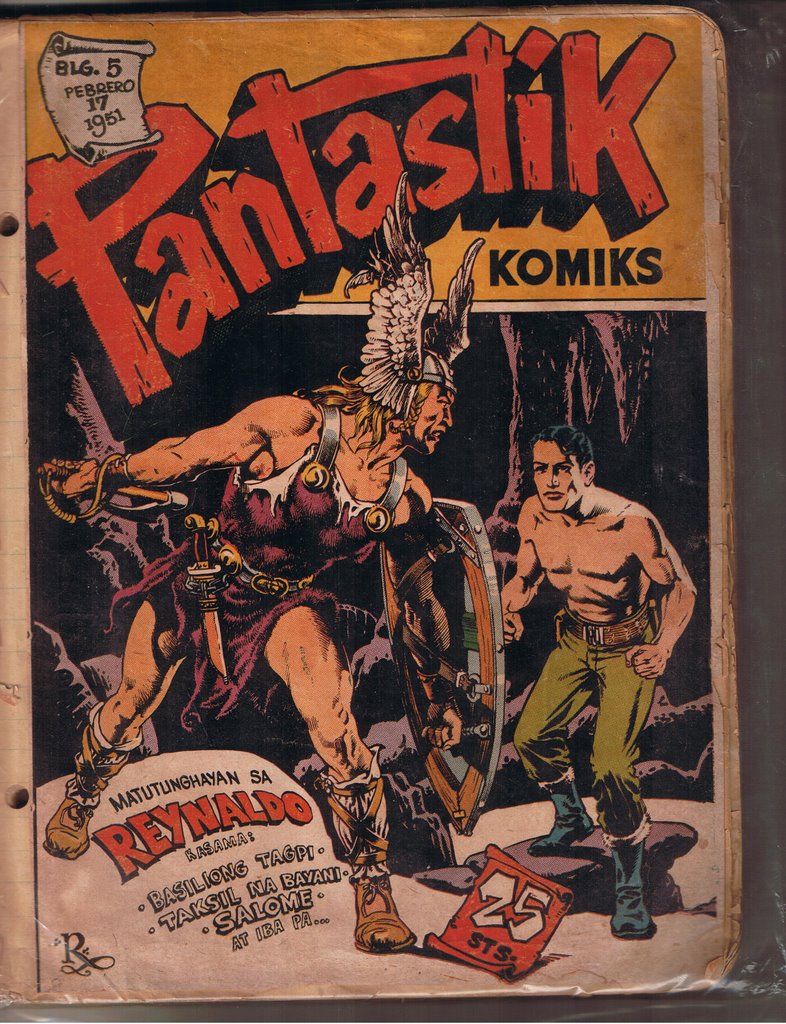
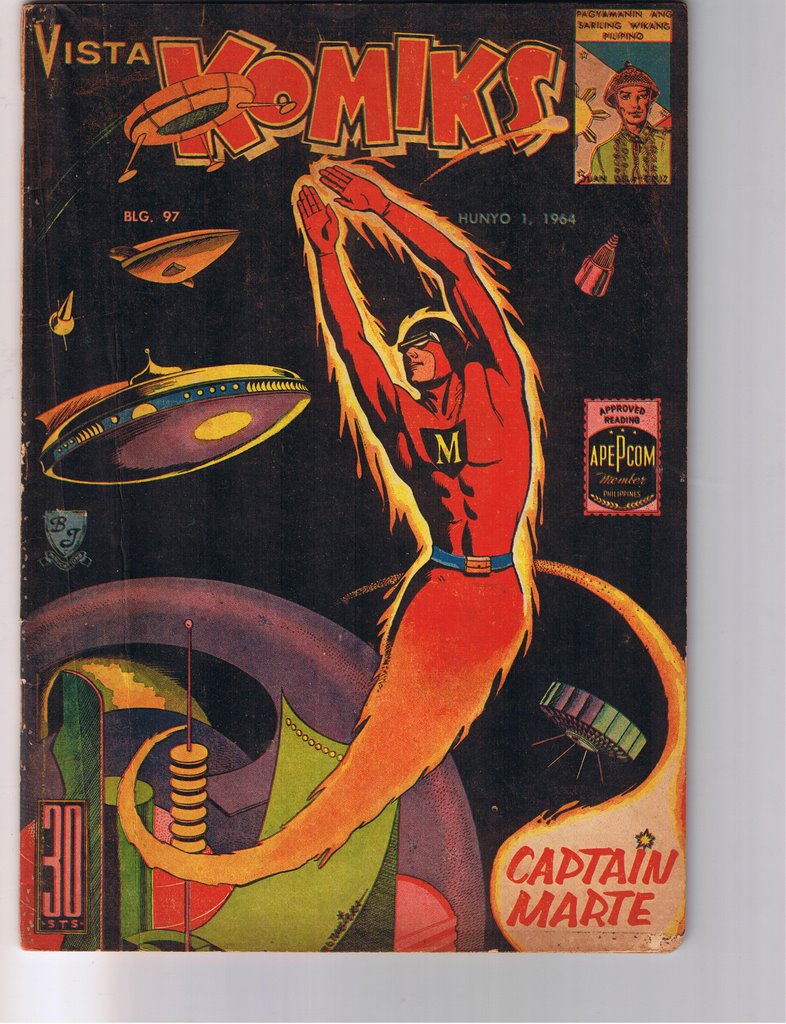
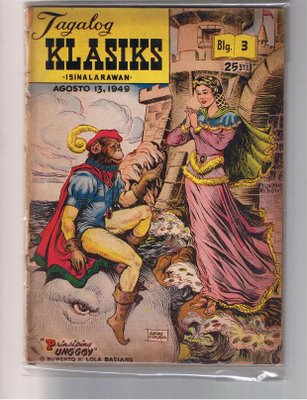
"Komiks" from the 1950s and 1960s are especially hard to come by, as even local antique shops do not carry an inventory of them. Unlike in America, where they have catalogues of all their known published comic books, the Philippines has no such publication in existence.
The closest publication I know that features only a partial list of Philippine comics-magazines is the book "Catalogue of Philippine Periodicals", published sometime in the 1950s. And even that book only lists some three or four titles of komiks.
Through the years, the komiks has gained a somewhat nostalgic value, a look back from the time when Filipinos regard it as their "national book". Sad to say, only a few people in the Philippines have managed to save komiks in their collection. I remember that the National Library had a few nice bound komiks sets that included some of the early issues of Pilipino Komiks, but over time, these somewhat had been lost, or became part of the "discarded" books the National Library regularly sells to the junk shops. Of course, this is because the librarians there regard komiks as publications "without any research value".
Why the rarity? Some important factors led to the rarity of komiks materials: Human neglect, termites, floods, fires, and the humid tropical climate easily destroy the pulp paper of komiks.
People who visit my house often wonder why I collect these things, and the reactions I usually hear from them are "how have you managed to collect them?", "have you read them all?", "My goodness, this komiks is older than me", or "Your collection is unique and weird" hehe...
So for those who had been emailing me to start a continuing gallery of old komiks, here it is. Enjoy!

Friday, June 23, 2006
The Essential Guide to World Comics
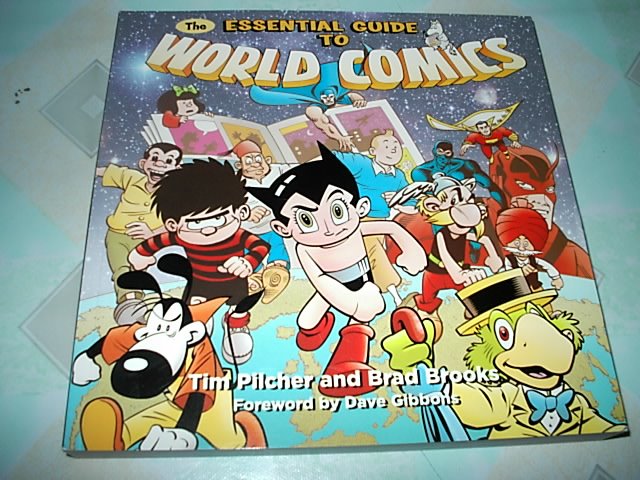
I finally bought a copy of "Essential Guide to World Comics" after being tipped by my friend Reno Maniquis that it is already available in Powerbooks.
I think this book is very important since it is the first book to examine in relative detail the comparative comics culture of the different countries of the world.
I am very glad that the rich Philippine comics tradition, hitherto neglected by international comic historians, has earned a generous space in this book, as it relates the unique contributions of the Filipinos to world comics.
Tony Velasquez, the Father of Philippine Comics, was also chosen by authors Tim Pilcher and Brad Brooks, as one of their choices for world class comics creators, together with Japan's Ozamu Tezuka, Argentinian Alberto Breccia, India's Anant Pai, and Belgian Herge, among the few selected others.
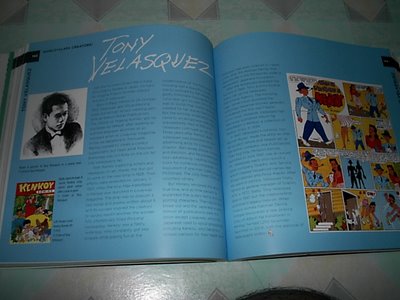 A special two-page spread tribute to Tony Velasquez, father of Philippine Comics.
I am also happy to find on the cover of the book our very own Kenkoy(as well as on the back), happily at home among the world's immortal cartoon characters like Astroboy, Dennis the Menace, Captain Marvel, and Tintin.
Interestingly, the book focuses more on the other lesser-known comics industries of Thailand, Vietnam, Hongkong, India, and many other Asian countries.
The Philippines occupies some six pages in the book (including the two-page tribute to Tony Velasquez), as well as some mention on the other sections of the book.
Also noteworthy are the sections on Africa, Europe, and the rest of the so-called "non-manga" and "non-superhero" comics industries.
Perhaps comics researchers and scholars may find the book to be disappointingly too brief and general, but I think the authors succeded in putting together in one compact, fascinating, and lavishly illustrated book a real essential guide to world comics, for the comics enthusiasts and collectors. Or for just anyone with even the slightest interest in comics.
So go ahead and treat yourself a tasteful of a book, and don't expect to borrow someone else's copy, I bet they will never lend their own copy :-)
Book details:
THE ESSENTIAL GUIDE TO WORLD COMICS
by Tim Pilcher and Brad Brooks
Illustrated, 319 pp.
A Chrysalis Publication, 2005
Wednesday, June 21, 2006
A Gallery of Francisco V. Coching's Early Cover Art
Finally, here's a gallery of some of the earliest komiks covers of the great Francisco V. Coching from my collection. For your viewing pleasure.
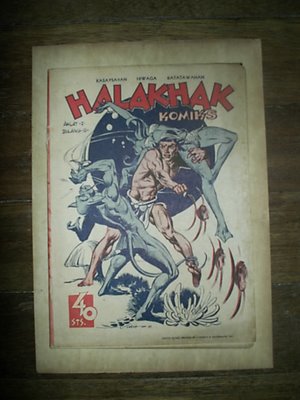 Halakhak Komiks #9, 1946. This is the only Coching cover for the extremely rare Halakhak Komiks, featuring Bulalakaw, one of his early komiks characters.
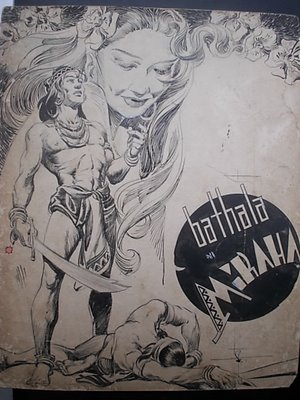 Liwayway Cover, Issue for October 9, 1947
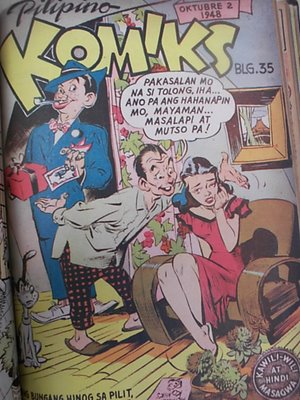 Pilipino Komiks#35, October 2, 1948
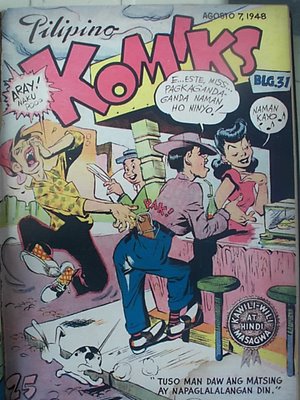 Pilipino Komiks#31, August 7, 1948
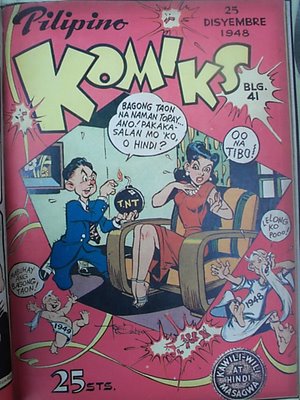 Pilipino Komiks#41, December 25, 1948
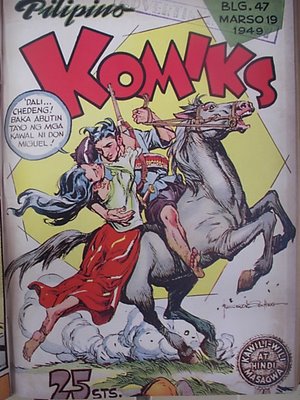 Pilipino Komiks #47, March 19, 1949
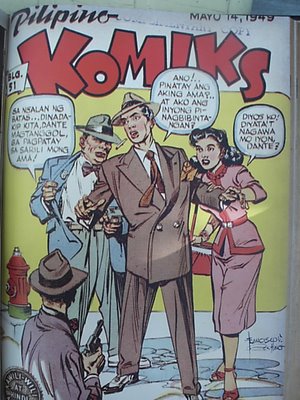 Pilipino Komiks #51, May 14, 1949
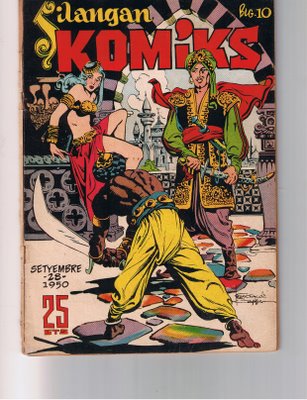 Silangan Komiks #10, September 28, 1950
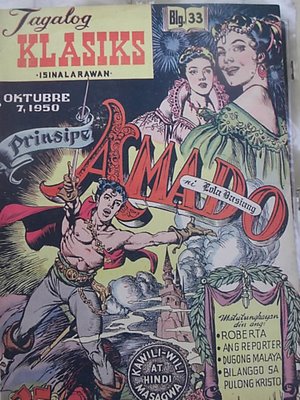 Tagalog Klasiks #33, October 7, 1950
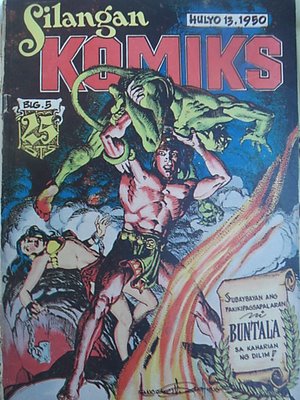 Silangan Komiks #5 July 13, 1950. This is one of my favorite Coching covers.
Halakhak Komiks #9, 1946. This is the only Coching cover for the extremely rare Halakhak Komiks, featuring Bulalakaw, one of his early komiks characters.Liwayway Cover, Issue for October 9, 1947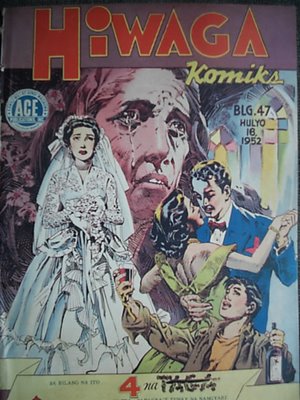 Hiwaga Komiks#47, July 16, 1952
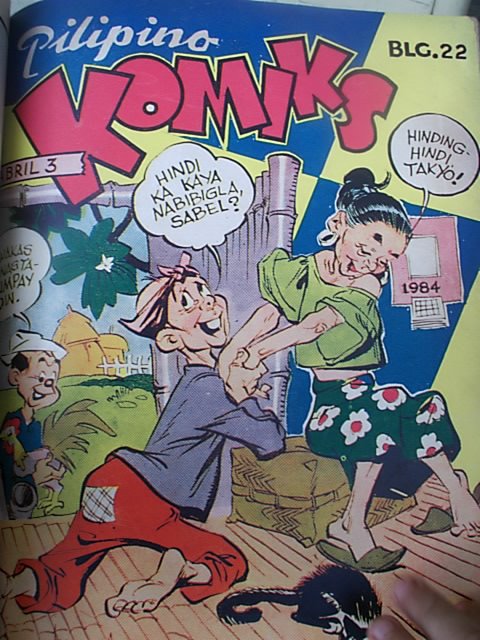 Pilipino Komiks#22, April 3, 1947 . Unknown to many, Coching was also a master of the cartoons, as shown in these following covers for the early issues of Pilipino Komiks. Actually his first comic strip in the Pilipino Komiks was Paloma, a cartoon character about a worldly and hilarious young Filipina who was possibly influenced by Tony Velasquez' Ponyang Halobaybay cartoons in the 1930s.
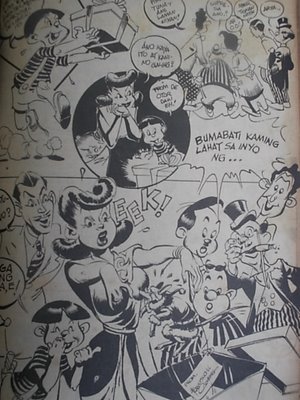 Paloma, the first cartoon character of Coching in Pilipino Komiks, 1947.
 Pilipino Komiks#35, October 2, 1948
 Pilipino Komiks#31, August 7, 1948
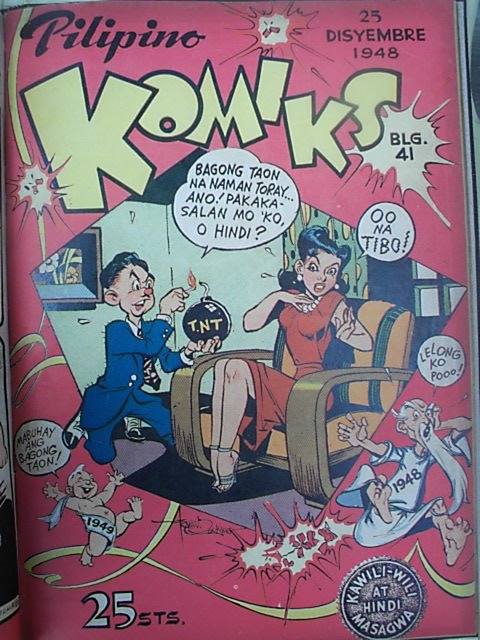 Pilipino Komiks#41, December 25, 1948
 Pilipino Komiks #47, March 19, 1949
 Pilipino Komiks #51, May 14, 1949
 Silangan Komiks #10, September 28, 1950
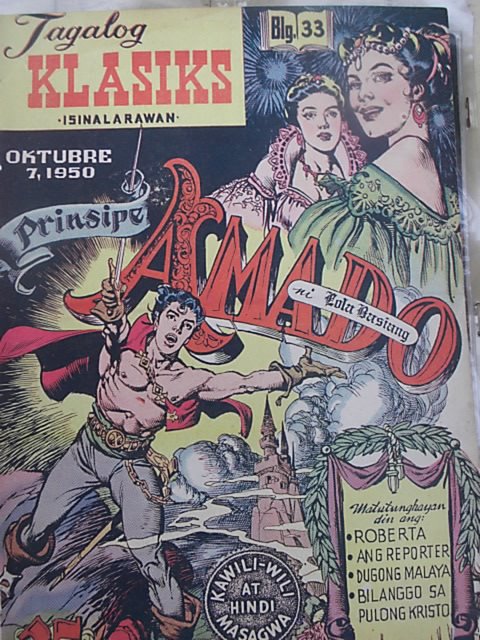 Tagalog Klasiks #33, October 7, 1950
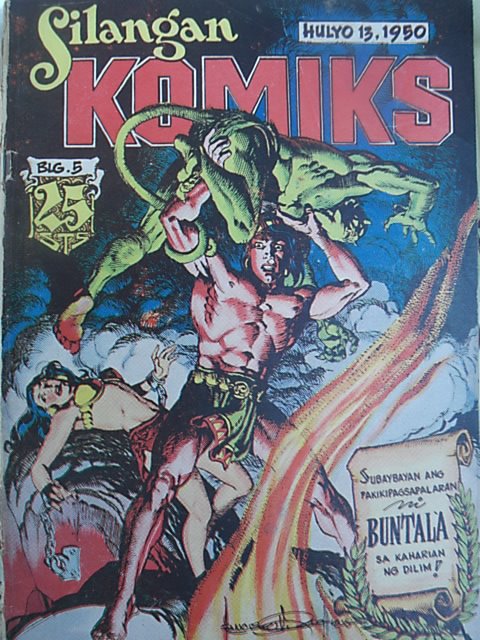 Silangan Komiks #5 July 13, 1950. This is one of my favorite Coching covers.
Thursday, June 01, 2006
The First Pinoy Komiks Superheroes
The very first Pinoy komiks superheroes appeared in 1946, right at the birth of the Philippine comics industry. Incidentally, that year also marked the independence of the Philippines from the United States, after surviving the destructive three-year Japanese Occupation.
After the war, a few enterprising individuals started the very first komiks-magazines in the Philippines: Halakhak Komiks and Pilipino Komiks. Although Halakhak Komiks did not contain any serious superhero story, it had, on the other hand, a Pinoy funny superhero called Siopawman, created by a young cartoonist named Larry Alcala.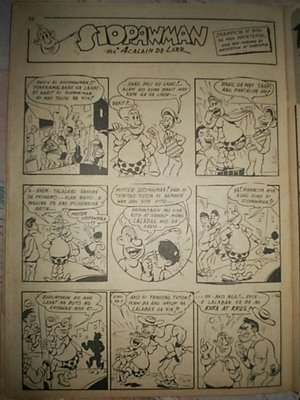 Siopawman by Larry Alcala may be the first, albeit fumbling, Pinoy komiks superhero.
IPO-IPO
The first true Pinoy komiks superhero was Ipo-ipo, a character created by Lib Abrena and Oscar del Rosario in 1946 in a Tagalog magazine called Magasin ng Pagsilang.
Ipo-Ipo is an interesting character, he gets his superpowers from the whirlwind. He acquires the speed of the wind and bullets fired into him just pass through his body.
Fresh from the horrors of the Japanese invasion, Abrena and Del Rosario pitted Ipo-ipo against the ruthless Japanese soldiers who refused to surrender, even after the unconditional capitulation of Japan in 1945.
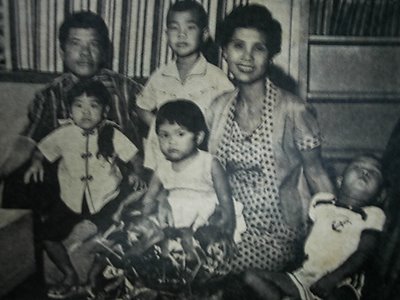 Mang Mars with wife and kids. Circa 1960s.
After the war, a few enterprising individuals started the very first komiks-magazines in the Philippines: Halakhak Komiks and Pilipino Komiks. Although Halakhak Komiks did not contain any serious superhero story, it had, on the other hand, a Pinoy funny superhero called Siopawman, created by a young cartoonist named Larry Alcala.
Siopawman by Larry Alcala may be the first, albeit fumbling, Pinoy komiks superhero.IPO-IPO
The first true Pinoy komiks superhero was Ipo-ipo, a character created by Lib Abrena and Oscar del Rosario in 1946 in a Tagalog magazine called Magasin ng Pagsilang.
Ipo-Ipo is an interesting character, he gets his superpowers from the whirlwind. He acquires the speed of the wind and bullets fired into him just pass through his body.
Fresh from the horrors of the Japanese invasion, Abrena and Del Rosario pitted Ipo-ipo against the ruthless Japanese soldiers who refused to surrender, even after the unconditional capitulation of Japan in 1945.
 Ipo-Ipo, the very first true Pinoy superhero: how can you beat a superhero that you cannot hit?
LAGIM
Lagim first appeared in Pilipino Komiks #1 in 1947, created by Cris Caguintuan. Like Ipo-ipo, Lagim battles the Japanese forces who would not surrender. Lagim gets his power from a headgear given to him by a scientist named Dr. Malasakit. The headgear makes Lagim's strength twice that of a man. Unlike Ipo-ipo, Lagim is vulnerable, he could be hit by bullets. Yet, luck and his double-strength was enough to defend people from the evil forces.
He later saved a boy named Levy who became his sidekick. 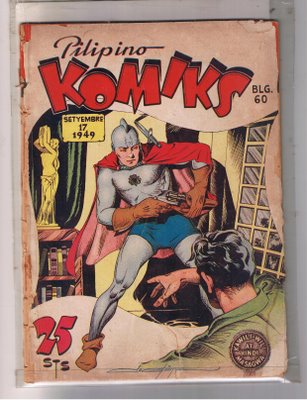 Possibly influenced by Batman, Lagim even had a sidekick named Levy, whose costume was similar to Robin.
VARGA
In July of 1947, Mars Ravelo created Varga in Bulaklak Maazine. Varga was actually the first Darna, and she also had an alter-ego named Narda. When Ravelo left Bulaklak and was hired in Ace Publications, he re-created Varga and renamed her Darna.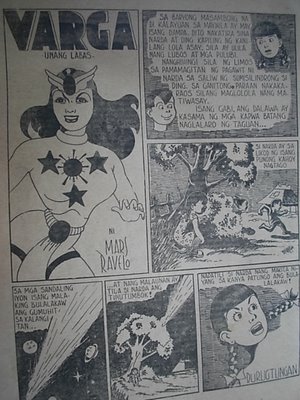 Yes, the original Darna was named Varga
In 1950, Darna appeared in Pilipino Komiks, re-created by Mars Ravelo and superbly illustrated by Nestor Redondo. The first story of Darna tells of her battles against the evil Valentina.
A TRADITION OF PINOY KOMIKS SUPERHEROES
More than any other superhero, Darna opened the floodgates of superhero stuff in Philippine comics. Aside from being the first komiks superhero to capture the attention of Pinoy komiks readers, Darna also lay claim as the first superhero to appear in the movies, with Rosa del Rosario in the lead role.
Indeed, throughout the years, Darna's commercial appeal proved her ultimate strength. In the 1970s, there were more movies about her, the top female stars of Philippine movies personifying her like Vilma Santos, Liza Moreno,Anjanette Abayari, to name a few. In mid-1970s, there was even a komiks named solely after her:Darna Komiks.
ENTER CAPTAIN BARBELL
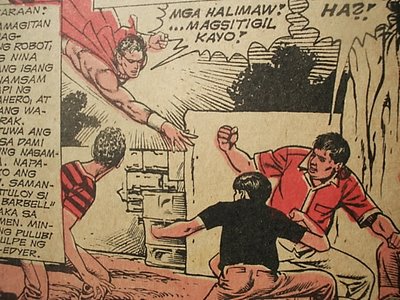
Captain Barbell is another creation of Mars Ravelo, suited for the masculine readers of his komiks. Captain Barbell first appeared in Pinoy Komiks in 1963, and was superbly illustrated by Jim Fernandez. 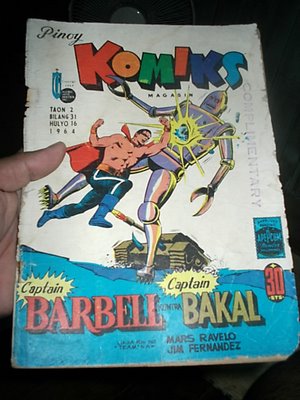
Captain Barbell Versus Captain Bakal, Pinoy Komiks 1964
Like Darna, Captain Barbell also had an alter-ego named "Tenteng", who is socially disavantaged,i.e., poor, and not very good looking. In the beginning issues of the komiks series, we see Tenteng being maligned by people above his social class, rejected by the woman he loves because he was ugly.
In a society in which the poor outnumbers the rich, Captain Barbell struck a chord among Pinoy komiks readers. Finally, here is a superhero whom they can identify with. Someone whose kindness at heart had blessed him with a superpower, the superior strength and the ability to fly, to help those who are poor and dowtrodden.
Captain Barbell also had his fair share in the movies; his character was personified in the screen by Dolphy, Bob Soler, Herbert Bautista, Edu Manzano, Bong Revilla, and Richard Gutierrez, being the latest.
MARS RAVELO: A KOMIKS SUPERHERO
More than any other komiks writer, it was Mars Ravelo who entrenched the tradition of superheroes in Philippine komiks. He had created more superheroes than any other Filipino comics writer. Yet, one can see that most of his superheroes were rooted from the poor and the disadvantaged, yet gifted with the values that are truly Filipinos. His superheroes are humans too, after all, they have their weaknesses, their human traits, and most of all compassion even for their enemies.
Why would Mars Ravelo concentrate so much on superheroes whose alter-egos are poor and downtrodden? Perhaps the answer lies within his own personal experiences. Mars grew up poor in a poor society. He tells of his experiences that he was so poor he was barely able to go to school. He never finished schooling though. "My teachers never liked me", he said, "And I never liked my teachers".
His first job was a janitor. Ravelo said "In everything I do I wanted to be #1, and when I became a janitor, well, I wanted to become the number 1 janitor"
Well, he did. It was in his personality to give his best in his every endeavor. And so, when he became a komiks writer, he was damned the best among them. Wether it was superhero stuff like Darna, or comedy like Buhay Pilipino, or heavy drama like Roberta, Ravelo was peerless.
I think Ravelo can truly personify his superheroes. He had lived like one.
Mang Mars with wife and kids. Circa 1960s. 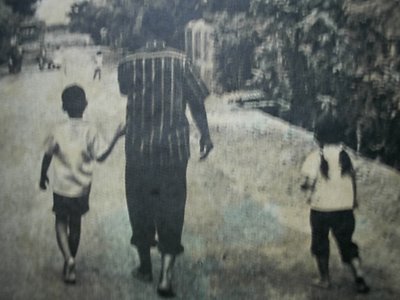 A barefooted Mars Ravelo, with two of his children, walking towards his fish pens in Cavite. Circa 1960s.
Monday, May 29, 2006
Captain Barbell
Okay, I accidentally watched last Monday evening the first episode of GMA-7's much-publicized Captain Barbell TV series. I said "accidentally" because I did not have any plan at all to watch it.
I was deeply disappointed by their Darna tele-version, and I pre-judged that now, GMA-7 will not be able to come up with even a satisfactory rendition of Mars Ravelo's most famous superhero.
I was watching 24 Oras, dozed off a little during Pia Guano's report on Kapuso stars ( plus Mike Enriquez' overacting intro of her) , I was awakened to find myself already watching Captain Barbell. Well, since I'm very comfortable lying on my sofa, why not give it a chance and perhaps see just what GMA-7 has stored for the first episode.
Frankly and honestly, I am very impressed with the first showing. It is fast-paced and superbly edited. But the real strength lies on its special effects. It is not unexpected though, as GMA-7 had repeatedly boasted that they really poured big money towards the production. It is also a strategy to make a big first impression so that the viewers will be sure to come back each evening.
Superman Copy
It is only deplorable that GMA7's Captain Barbell deviated from its original storyline, even though it claimed it is Mars Ravelos' Captain Barbell. Plotwise, there is little similarity to the original Captain Barbell who first debuted in Pinoy Komiks in 1963.
I just love Pinoy Komiks!
I was deeply disappointed by their Darna tele-version, and I pre-judged that now, GMA-7 will not be able to come up with even a satisfactory rendition of Mars Ravelo's most famous superhero.
I was watching 24 Oras, dozed off a little during Pia Guano's report on Kapuso stars ( plus Mike Enriquez' overacting intro of her) , I was awakened to find myself already watching Captain Barbell. Well, since I'm very comfortable lying on my sofa, why not give it a chance and perhaps see just what GMA-7 has stored for the first episode.
Frankly and honestly, I am very impressed with the first showing. It is fast-paced and superbly edited. But the real strength lies on its special effects. It is not unexpected though, as GMA-7 had repeatedly boasted that they really poured big money towards the production. It is also a strategy to make a big first impression so that the viewers will be sure to come back each evening.
Superman Copy
It is only deplorable that GMA7's Captain Barbell deviated from its original storyline, even though it claimed it is Mars Ravelos' Captain Barbell. Plotwise, there is little similarity to the original Captain Barbell who first debuted in Pinoy Komiks in 1963.
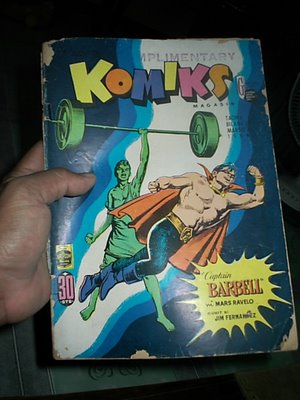
The original Captain Barbell first appeared in Pinoy Komiks in 1963. Written by the great Mars Ravelo, this series was illustrated by Jim Fernandez.
The plot is obviously copied from Smallville, with all the familiar scenes like a spaceship crashing to Earth, with a farm couple rescuing a small boy inside who would be the future Captain Barbell, plus the boy showing feats of unusual power like lifting a tractor and a tree.
But perhaps the most embarrasing copy is the introduction of the Askobar (Asidong Kontra Barbarium), which is of course, an imitation of Superman's Krypton. Like the Krypton, the Askobar is also a crystalline substance and has the power to make Captain Barbell weak. The most ridiculous part is the fact that the General (more or less a copy or Lex Luthor), can defeat Captain Barbell just by holding a piece of krypton in his hand and showing it in the superhero's face, like saying "in your face, Captain Barbell!"
Perhaps it would have been more slightly original if Commander X( the loyal lieutenant of the General) was given a battle suit made up of Askobar to counter the Barbarium suit worn by Captain Barbell.
Generally, though, with all its faults, I liked the first showing of Captain Barbell. I must admit I enjoyed watching it, and has exceeded my expectations, although I just felt a little uneasy with Snooky's wig; it seemed to be always falling from her head.
I congratulate GMA-7 for resurrecting one of Pinoy Komiks most popular superheroes, and I intend to watch it now every evening.
I just love Pinoy Komiks!
Thursday, May 25, 2006
Komiks is a Virtual Time Machine

Recently, a group of students visited my house to interview me for their thesis regarding Philippine Komiks. I think this has been the fifth time I was interviewed by students to help them in their thesis on komiks.
One of the first questions I had to answer was why I collect komiks and not comics? Komiks, of course, refers to Tagalog comics, and comics--well, any english or American comics.
I collected komiks not because of my patriotism, but rather because of the reason that I enjoy reading them. I loved the Tagalog language, it is beautiful, it is poetic, and it is the language I speak and had grown up with.
I loved the stories about some old Philippine legends, myth, or period stories in old musty komiks. Of course the drawings take the second half of the credit. You can't go wrong in a komiks written by Mars Ravelo, Pablo Gomez, and Clodualdo del Mundo, and illustrated by Coching, Redondo, Alcala, or Carrillo.
I never collected American comics even though they are also magnificently illustrated. I just can't identify myself with X-Men, Superman, Batman or the Fantastic Four. I have never read a single American comic book. Even the only one I bought-The Death of Superman-had to be sold cheap in Ebay because I just did not read it. Of course, there is nothing wrong with American comics, only reading it is not just my cup of tea.
For me Tagalog Komiks is a reflection of our rich cultural heritage. Reading it is like riding a virtual Time Machine where you can choose to travel which period in Philippine history you want to go to. 1940s? Read the earliest issues of the Halakhak and Pilipino Komiks.
You want to feel what it was like to live in the 1950? Then read the Hiwaga, Mabuhay, Silangan, or Tagalog Klasiks, and there not only will you find period stories but period advertisements as well when Pepsi-Cola was just 25 centavos a bottle.
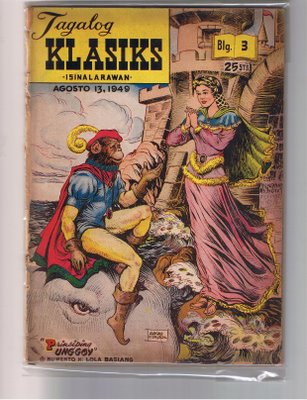
The 1960s will be the years of GASI and PSG Publishing and you can read there stories of the roaring 60s, and learn about the fashion of the period: the Beatles, the baston pants, the elevator shoes, the Elvis hairstyle. You will find it all there including past gossips of Pinoy movie stars like Amalia Fuentes, Nora Aunor, Susan Roces, Tirso Cruz and many more.
I think this is something unique to the Tagalog Komiks, that it is a microcosm of Filipino society in general as it had evolved throught the years. By reading komiks, the young ones can experience the years gone by, while the older ones can reminisce the good old days.
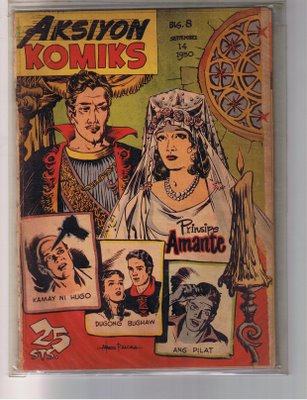
That is only one of the reasons why I enjoy reading Tagalog Komiks.
Subscribe to:
Comments (Atom)