Monday, May 29, 2006

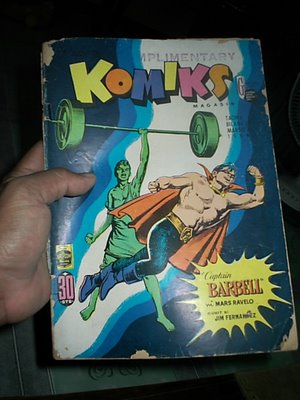
Captain Barbell

Okay, I accidentally watched last Monday evening the first episode of GMA-7's much-publicized Captain Barbell TV series. I said "accidentally" because I did not have any plan at all to watch it.

I was deeply disappointed by their Darna tele-version, and I pre-judged that now, GMA-7 will not be able to come up with even a satisfactory rendition of Mars Ravelo's most famous superhero.

I was watching 24 Oras, dozed off a little during Pia Guano's report on Kapuso stars ( plus Mike Enriquez' overacting intro of her) , I was awakened to find myself already watching Captain Barbell. Well, since I'm very comfortable lying on my sofa, why not give it a chance and perhaps see just what GMA-7 has stored for the first episode.

Frankly and honestly, I am very impressed with the first showing. It is fast-paced and superbly edited. But the real strength lies on its special effects. It is not unexpected though, as GMA-7 had repeatedly boasted that they really poured big money towards the production. It is also a strategy to make a big first impression so that the viewers will be sure to come back each evening.

Superman Copy

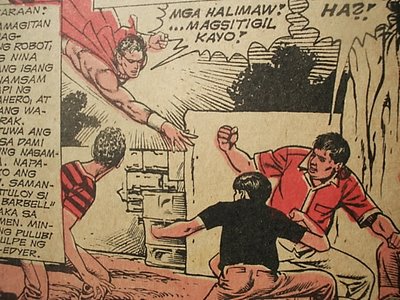
It is only deplorable that GMA7's Captain Barbell deviated from its original storyline, even though it claimed it is Mars Ravelos' Captain Barbell. Plotwise, there is little similarity to the original Captain Barbell who first debuted in Pinoy Komiks in 1963.


The original Captain Barbell first appeared in Pinoy Komiks in 1963. Written by the great Mars Ravelo, this series was illustrated by Jim Fernandez.

The plot is obviously copied from Smallville, with all the familiar scenes like a spaceship crashing to Earth, with a farm couple rescuing a small boy inside who would be the future Captain Barbell, plus the boy showing feats of unusual power like lifting a tractor and a tree.

But perhaps the most embarrasing copy is the introduction of the Askobar (Asidong Kontra Barbarium), which is of course, an imitation of Superman's Krypton. Like the Krypton, the Askobar is also a crystalline substance and has the power to make Captain Barbell weak. The most ridiculous part is the fact that the General (more or less a copy or Lex Luthor), can defeat Captain Barbell just by holding a piece of krypton in his hand and showing it in the superhero's face, like saying "in your face, Captain Barbell!"

Perhaps it would have been more slightly original if Commander X( the loyal lieutenant of the General) was given a battle suit made up of Askobar to counter the Barbarium suit worn by Captain Barbell.

Generally, though, with all its faults, I liked the first showing of Captain Barbell. I must admit I enjoyed watching it, and has exceeded my expectations, although I just felt a little uneasy with Snooky's wig; it seemed to be always falling from her head.

I congratulate GMA-7 for resurrecting one of Pinoy Komiks most popular superheroes, and I intend to watch it now every evening.


I just love Pinoy Komiks!

Thursday, May 25, 2006

Komiks is a Virtual Time Machine


Recently, a group of students visited my house to interview me for their thesis regarding Philippine Komiks. I think this has been the fifth time I was interviewed by students to help them in their thesis on komiks.

One of the first questions I had to answer was why I collect komiks and not comics? Komiks, of course, refers to Tagalog comics, and comics--well, any english or American comics.

I collected komiks not because of my patriotism, but rather because of the reason that I enjoy reading them. I loved the Tagalog language, it is beautiful, it is poetic, and it is the language I speak and had grown up with.

I loved the stories about some old Philippine legends, myth, or period stories in old musty komiks. Of course the drawings take the second half of the credit. You can't go wrong in a komiks written by Mars Ravelo, Pablo Gomez, and Clodualdo del Mundo, and illustrated by Coching, Redondo, Alcala, or Carrillo.

I never collected American comics even though they are also magnificently illustrated. I just can't identify myself with X-Men, Superman, Batman or the Fantastic Four. I have never read a single American comic book. Even the only one I bought-The Death of Superman-had to be sold cheap in Ebay because I just did not read it. Of course, there is nothing wrong with American comics, only reading it is not just my cup of tea.

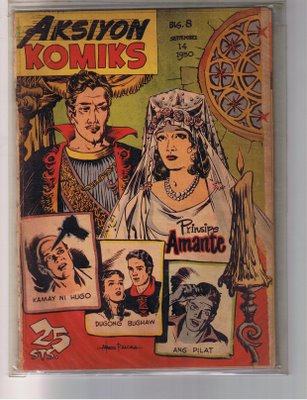
For me Tagalog Komiks is a reflection of our rich cultural heritage. Reading it is like riding a virtual Time Machine where you can choose to travel which period in Philippine history you want to go to. 1940s? Read the earliest issues of the Halakhak and Pilipino Komiks.

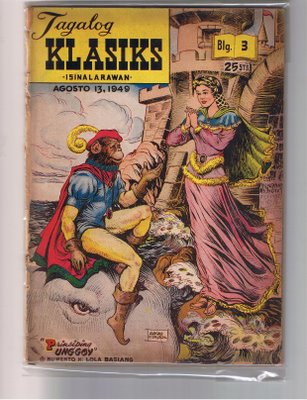
You want to feel what it was like to live in the 1950? Then read the Hiwaga, Mabuhay, Silangan, or Tagalog Klasiks, and there not only will you find period stories but period advertisements as well when Pepsi-Cola was just 25 centavos a bottle.


The 1960s will be the years of GASI and PSG Publishing and you can read there stories of the roaring 60s, and learn about the fashion of the period: the Beatles, the baston pants, the elevator shoes, the Elvis hairstyle. You will find it all there including past gossips of Pinoy movie stars like Amalia Fuentes, Nora Aunor, Susan Roces, Tirso Cruz and many more.

I think this is something unique to the Tagalog Komiks, that it is a microcosm of Filipino society in general as it had evolved throught the years. By reading komiks, the young ones can experience the years gone by, while the older ones can reminisce the good old days.


That is only one of the reasons why I enjoy reading Tagalog Komiks.

Sunday, May 21, 2006

Ruben "Rubeny" Yandoc Comic Art Sale


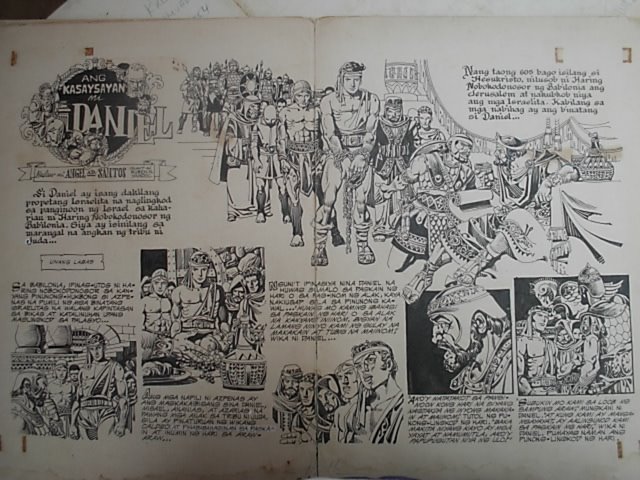
I am currently selling some nice Rubeny Yandoc comic pages from the early 1960s. These pages were published in the short-lived KENKOY KOMIKS, as part of the popular Bible series began by Emil Rodriguez in 1959. When Rodriguez left for the U.S., Yandoc took over the series.


Anyone familiar with Philippine comics will notice that there is a marked similarity between the drawing styles of Emil Rodriguez and Rubeny Yandoc in this Bible series. Apparently, Tony Velasquez wanted Yandoc to illustrate using the the same style of Rodriguez, in order to give a sense of continuity to the series.
A chameleon of an artist, Yandoc managed to imitate the lines of Rodriguez, while at the same time injecting the uniqueness of his own style.

Tony Velasquez was greatly impressed, and he gave Yandoc the permanent job of illustrating the series. Says Velasquez "Those Bible pages by Yandoc were some of the best illustrated artworks I have seen as an editor. I was very proud that these artworks appeared in my very own Kenkoy Komiks" Source: Tony Velasquez, Memoirs(unpublished).

Indeed, many consider Yandoc's work in the Bible as one of the finest works in the history of Philippine comics. It was lavishly illustrated, superbly rendered, and magnificently composed. Perhaps Yandoc may not be that good when illustrating westerns or romances, but when it comes to period stories,like the Bible or those familiar cloak and dagger stories, he was simply peerless.

When Yandoc left for the U.S. in the early 1970s to accept regular illustrating jobs in the U.S., the Philippine comics industry lost one of its truly great artists.

According to Comic Book Artist Magazine#4,(published in Sept.2004 in U.S.), Yandoc "undoubtedly had one of the most peculiar styles of the Filipinos, and apparently was an influence on that other arch-stylist, Alex Nino.

Throughout the 70's, he was a constant presence in DC's horror books, drawing an astonishing 130 strips, as well as squeezing in a handful of war stories like weird war tales and Sgt. Rock. He also moonlighted on Warren and Marvel where he contributed to Unknown Worlds of Science Fiction and Marvel Spotlight. Yandoc was a big favorite among the American readers".

Now, collectors will have a chance to own some of these great pages from those Bible series. I have put a "Buy It Now" option so that collectors may be able to spot which page they liked and purchase it instantly, without having to go through the effort of watching, waiting and bidding, and maybe losing at the last minute.

Kindly copy and paste this to your browser to see the auction:

http://www.ebay.ph/viItem?ItemId=6282455027

Be sure to click on the link that says "View Seller's other Items" to see all the pages I'm selling.

These pages would look great framed in a comics library, office or studio. Or simply as a souvenir from one of the great artists of the Golden Age of Philippine Comics.

Tuesday, May 09, 2006

Pancho Villa: First Filipino World Boxing Champion

The great symbol of the 1920s era in the Philippines was Pancho Villa, the most brilliant fighter of the period that bred such great boxers as Cabanela, Young Dencio, Frisco Concepcion, Clever Sencio, and the Flores Brothers.

Pancho Villa placed the Philippines on the map by winning boxing laurels abroad, defeating even the toughest flyweights in the United States. His fighting style was characterized by a relentless attack, a raging bull onslaught, and explosive and devastating punches.

His total fights of 105 (some only weeks in between) was a record in itself, elevating him into one of the great fighters in the history of boxing, and certainly one of the greatest Asian brawlers to step on the ring. The prestigious Ring Magazine, the bible of boxing aficionados, ranked Villa as one of the 100 Greatest Boxers of All Time.

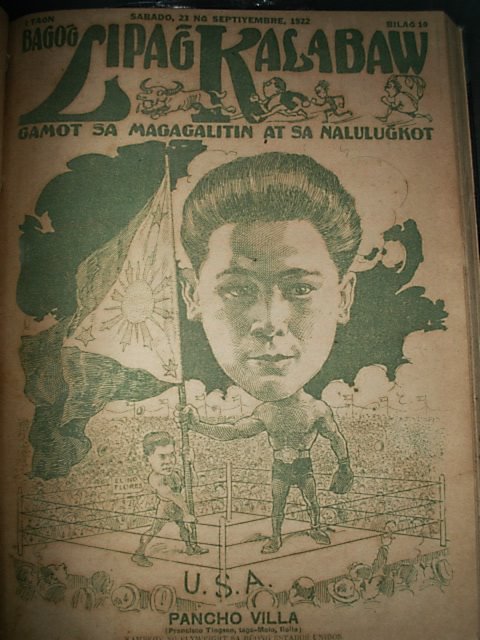
Cover for September 1922 issue of Lipang Kalabaw magazine.
Caricature by Fernando Amorsolo.Dennis Villegas collection.


Born Francisco Guilledo in Negros Occidental on August 1, 1901, he adopted the name Pancho Villa from the name of Mexico's famous revolutionary. Villa fought exclusively in the Philippines from 1919 through April 1922, often facing much larger men. In that period of time, he lost only three fights and captured two Filipino titles. In 1922, the American boxing promoter Frank Churchill discovered Villa in one of the amateur fights in Manila. Impressed by the young man's power punches, Churchill took Villa to the United States. The young Filipino fought two no-decision bouts in New Jersey, losing-according to the newspapers, to Abe Goldstein and Frankie Genaro.

The American press and public were at first slow to take notice of Villa. Churchill had difficulty arranging fights in major venues until, for almost no money, he got Villa and another Filipino, Elino Flores, on a card at Ebbets Field, home of the Brooklyn Dodgers. Each fighter won his bout, and the crowd gave Villa a standing ovation.

Cover for a September 1922 issue of Telembang magazine.
Portrait by Fernando Amorsolo.Dennis Villegas magazine collection

Three months after his arrival in the U.S., Villa knocked out American Flyweight champion Johnny Buff in the eleventh round to win the American flyweight title. To catch a glimpse of Villa's devastating attack, here's a very rare footage from his magnificent fight with Buff:


Genaro took the title back in 1923 in a 15-round decision that most observers believed belonged to Villa. Meanwhile, British flyweight champion Jimmy Wilde had come to New York seeking the world title. Wilde was then considered the best flyweight in the world. Although Genaro was a likely opponent, the now wildly popular Villa was considered a better draw.

In the much-anticipated match at New York's Polo Grounds on June 18, 1923, in front of thousands of spectators, Villa and Wilde set out for one of the most exciting fights in boxing history. Villa started slow, while Wilde started fast, throwing power punches that meant to knock-out the Filipino slugger. Villa defended successfully and threw some power punches of his own in retaliation, most of them landing and almost knocked down Wilde. In the second round and onwards, however,Villa started to display his relentless attacking style, peppering Wilde with punches from both hands. In the seventh round, Villa battered Wilde to a state of helplessness, knocking him
flat, face down in canvas, ending the fight --and Wilde's career. The 20,000 spectators were ecstatic with Villa's victory--shouting "Viva Villa!" "Viva Villa!"

Here's a very rare footage of that famous bout, now considered one of the greatest slug fests in boxing history:


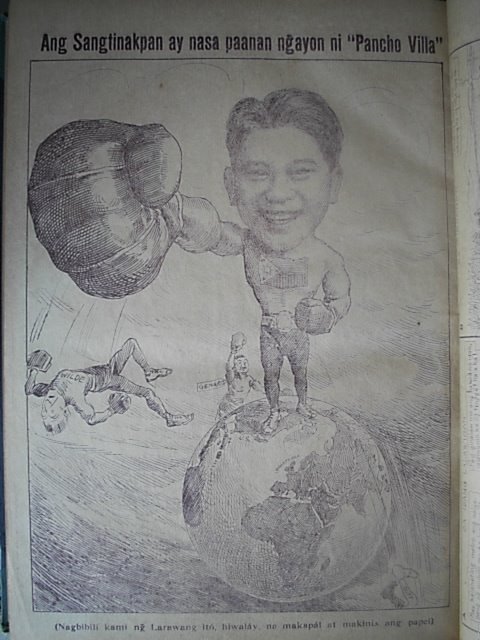
Pancho Villa caricature by cartoonist Jorge Pineda, Lipang Kalabaw 1923.
Dennis Villegas magazine collection

Villa was known during his time as being one of the cleanest boxers, always showing concern for his opponents and immediately turning away and walking to neutral corner after knocking down his opponent. This was before there was a rule of going to a neutral corner while the downed opponent is being counted by the referee.

Villa returned to the Philippines in September 1924, amidst jubilant reception (of his countrymen, not unlike the ones we do when Manny Pacquiao returns from a successful fight). He was invited for a parade and reception at the Malacanang Palace by then Governor General Leonard Wood, together with some of the big names in Philippine politics--then Senate President Manuel Quezon and House Speaker Sergio Osmena. It was known that General Wood and Senator Quezon were not in good terms, but the presence of the world champion temporarily set aside the personal differences of the two men.

As World Champion, Villa collected into his person all the swank and swagger of the era and the whole country felt an electrifying pride in his rise from rags to riches, his fetish for the most magnificent wardrobe, his expensive silk shirts and fashionable hats, his pearl buttons and gold cuff links, and his regal servants. He had a servant to massage him, another to towel him, a valet to put on his shoes, another to help him put on his trousers, still another valet to comb his hair, to powder his cheeks, and spray him with the most expensive perfume.

The Filipinos adored his extravagance, treating him almost as their crowned king. For a time, Villa was the most beloved figure in the Philippines--he had captured the heart and admiration of his countrymen, and he well thought he deserved it. He was perhaps more idolized as a showman, than as a boxer, and he was conscious of it. Never before had the Filipinos been electrified by the pride that their own kind had become the Champion of the World.

Villa successfully defended his title several times in the U.S. and the Philippines, and for a time, was considered practically invincible in the ring. Before returning to the United States, Villa defeated in Manila another great Filipino boxer, the mighty Clever Sencio. It was destined to be Villa's final victory in the ring--and no one among the thousands of cheering spectators knew it at that time.

In 1925, Villa fought in a non-title bout with Jimmy McLarnin in Oakland, United States. Weak from the recent extraction of a wisdom tooth, Villa lost the decision. It was destined to be his last fight. Another visit to the dentist resulted in the discovery of an infection and the extraction of three more teeth. Villa ignored the dentist's instructions to rest and return for a follow-up visit, and instead indulged in a week-long party.

The infection worsened, and by the time Villa's trainer, Whitey Ekwert, discovered the fighter's distress and rushed him to the hospital, it was too late. Villa died on July 14, 1925, of Ludwig's Angina, an infection of the throat cavity. He was survived by his wife Gliceria*.


Villa's untimely death at the young age of 24 broke the nation's heart. The hysteria that possessed the masses during his funeral was the most feverish of its era. Filipinos openly wailed in the streets while their hero's casket was being borne to its sad destination.

Such was the brief but shining career of one of the greatest Filipino boxers who ever lived.

panchovilla
Pancho Villa's grave inside the Manila North Cemetery.
The grave is being cleaned everyday by a tomb caretaker.

In 1989, Pancho's widow Gliceria- then 84 - insisted that a gambling syndicate conspired to murder the champion because of big losses in the Villa-McLarnin non-title fight. Pancho was a heavy favorite to beat McLarnin and the syndicate placed huge amount of bet to Villa. Mrs. Guilledo claimed that her husband was injected an overdose of anesthetic on instructions of the syndicate*.

In 1994, Villa was inducted posthumously in the International Boxing Hall of Fame, the second Filipino to earn the recognition--after Gabriel "Flash" Elorde.

*NY Times July 15, 1925: Villa "...died at a hospital here [San Francisco] today while undergoing an operation for an infection of the throat that developed from an infected tooth. Dr. C.E. Hoffman said the boxer suffocated under the anesthetic. Dr. Hoffman was preparing to operate when Villa's heart stopped. Artificial respiration failed to revive the patient."

Monday, April 03, 2006

Searching for Jose Zabala-Santos


I have never met the great cartoonist Jose Zabala-Santos in person. Everything I knew about him I learned from reading articles written about him, and my interviews of his family, friends, and close students, including the famous artists Mauro Malang and Nonoy Marcelo.

In my conversations with the apostles, I learned a great deal about the master. Mauro Malang, one of Zabala-Santos' most devoted apostles, recounts, "As a young cartoonist in the 1950's, I sought out Mang Pepe to learn the techniques of cartooning. You see, he was my idol, and I insisted on calling him "master". I used to buy comics back then but only to clip the comic strips of Mang Pepe and compile them in my notebook. When I found out where he lived, I became a frequent visitor to his house. I would eat there and sometimes even sleep there. He helped me a lot during my early years as a comic artist"

Fine artist Mauro Malang remembers fondly his teacher Jose Zabala-Santos.

Nonoy Marcelo, was still a young kid when he used to frequent the home of the Jose Zabala-Santos. "He's actually my uncle" he said in my interview of him several years back, "my mother is Tio Pepe's sister. Tio Pepe taught me the basics of drawings when I was still a little boy. I think those years I spent learning from him became the foundation of my art as a cartoonist."

Like Mauro Malang and Nonoy Marcelo, I too am fascinated by the late great Jose Zabala-Santos. I want to know more about the master, even if only through the reminiscences of his family. And so one rainy day I decided to go to Malabon, where the great cartoonist lived all his life.

Jose Zabala-Santos lived in an obscure little place in Malabon called Kuatro Kantos. It was not very difficult to find his house as people still fondly remember Mang Pepe even though more than twenty years had passed since he died.

In front of a nearby Sari-sari store, some people were spending idle time to chat and I asked them where Mang Jose "Pepe" Zabala-Santos lived.

"That's the house of Mang Pepe", said one of the older women.

"Mang Pepe was our Santa Claus here" remembered one of the neighbors "he used to distribute candies, toys and coins to the neighborhood kid. Everybody here felt orphaned by a great father when he died. A very kind man"

Another neighbor said,"We cannot say anything against Mang Pepe. He is one of a kind, a poor philanthropist because whatever he has got on his wallet he would willingly give to those who are in need"

The street where Mang Pepe lived.

The house where Mang Pepe lived was simple and modest, a two-story structure of combined wood and concrete that sometimes gets flooded whenever there is high tide. The house is built near the banks of the Malabon River.

The modest and old Zabala Santos home in Kuatro kantos.

I soon met Aling Menrada Zabala-Santos, widow of Mang Pepe. A petite lady in her eighties, Aling Menrada happily welcomed me to their house. She remembers fondly her husband.

"He was a perfect husband", she smiles, "He goes home straight after work. No vices of any kind. During paydays he would buy and distribute candies to these neighborhood kids. On Sundays, he would bring the whole family to the Luneta and we would have a picnic. Everyone was happy. When he died, many people told me I could not find another person like him. Indeed, Pepe was one-of-a kind. He never had a grudge on anyone. He never complains even when his rights was being abused. He was that kind of person"

Mang Pepe's daughter, Lucy joined in the reminiscences of her great father.

"My Tatay" says Lucy "was a very shy person. He was so much unlike his cartoon characters, like the mischievous "Popoy" or the braggart "Lukas Malakas". He always reminded me and my siblings to be always kind to people, not to say anything against anyone. We grew up with those words of wisdom from a great father. We always keep that in mind"
The Zabala Santos Family in 1958.


For me, an image of Jose Zabala-Santos is starting to emerge, an image of a noble man with a serious countenance but who made the nation laugh through his cartoons and his genius in humor.

Jose Zabala Santos was born on July 20, 1911 in Calumpit, Bulacan. His parents, Severino Santos and Leoncia Zabala were of humble origins. The family migrated to Malabon when the father accepted a factory job there. Young Pepe was a quiet child whose childhood hobby was to draw stick figures in paper.

In college, he entered the U.P School of Fine Arts where he met and befriended another great cartoonist, Francisco Reyes, the creator of "Kulafu". It was the beginning of a life-long friendship. Reyes would also become a frequent visitor in Pepe's home. The hospitality of the Zabala-Santos' household was known throughout Malabon. Not surprisingly, a good number of comic artists frequented it, like Liborio Gatbonton, Lib Abrena, Larry Alcala, Romeo Tabuena, and even Tony Velasquez. Yet it was Reyes who visited most of the time. Reyes even became a godfather to one of Zabala-Santos' children, Jimmy.

Francisco Reyes foreground, with his best friend, Jose Zabala Santos at the background


In 1935, Reyes introduced Pepe to Tony Velasquez who was then the art director of the Liwayway magazine. Tony Velasquez gave Pepe his first job as cartoonist in the comics section of the Liwayway.

In the Liwayway, Zabala-Santos created a series of cartoons about a hilarious but half-witted provinciano named Sianong Sano. During that time, Kenkoy was the most popular cartoon character, followed closely by Kulafu and Sianong Sano.

Velasquez immediately noticed Pepe's genius in humor and cartooning, and encouraged him to create other cartoon characters that would be identified with him. Pepe created some of the most popular characters in the history of Philippine cartoons: Popoy, a mischievous but lovable kid like Kenkoy, Lukas Malakas, a chevalier ready to defend ladies, most especially the beautiful ones.

He was also the originator of the Slice of Life cartoon page that was popularized by Larry Alcala, also a one-time apprentice of Mang Pepe.

A Slice of Life cartoon by Jose Zabala Santos. Larry Alcala later borrowed this panoramic cartoon style, and popularized it in the 1980s.

Having become busy with cartooning, Pepe was not able to finish his course at the U.P., but instead studied cartooning in a correspondence course.

After the war, Zabala-Santos joined the creative team of the Halakhak Komiks, where he contributed covers and a "Popoy-like" character named Pinoy. The komiks did not last though and for a few months, Mang Pepe was jobless.

Fortunately, in 1947, when Tony Velasquez founded the Ace Publications, and one of the first cartoonists he invited to contribute was Jose Zabala-Santos. "Pepe is a cartoonist I admire deeply" said Velasquez "I liked his style."

Pilipino Komiks #3. Cartoon art by Jose Zabala Santos. This revealed the great esteem of Tony Velasquez to Jose Zabala Santos. Velasquez gave Zabala Santos cover job for one of the early issues of Pilipino Komiks.

Jose Zabala Santos cover art for Pilipino Komiks #5 1947

Velasquez and Zabala-Santos truly can relate and connect with each other on so many levels. Both were almost of the same age (Velasquez was only a year older). Both were timid and taciturn by nature, yet both were geniuses in their chosen fields.

Incidentally, Tony Velasquez was also taking up correspondence course in cartooning in almost at the same time that Zabala-Santos was, and Velasquez joked, "Pepe and I were really classmates you know, and we both studied under the guidance of the Postman"

In later years, when Martial Law was imposed in the country by President Marcos, Velasquez and Zabala-Santos(independently of each other) retired from cartooning in comics.

Remembers Velasquez "It was not a great time to be a cartoonist. And then I learned my friend Pepe retired also, so I thought I made a timely decision"

Jose "Pepe" Zabala-Santos, self-portrait 1973.

During the Martial Law, Francisco Reyes invited Zabala-Santos to work in Philippine Manufacturing Company that later became the Procter and Gamble (and still later, Unilever). The pay was meager but it was enough to sustain Mang Pepe's family. Fortunately by this time, Zabala-Santos' six children were already graduated from college so they were able to help in the family finances.

Says Aling Menrada "Pepe struggled hard to send all our children to school through his income as a cartoonist. Look, they are all professionals now!".

Mang Pepe's daughter Lucy, a librarian, was once offered an opportunity to work in the United States. She wanted to go but her father would not want her to.

Remembers Lucy "Tatay said why should I work for another country? It did not matter to him if I would be getting more income working in the U.S than working here. He told me that we should all serve our poor country first before serving other more wealthy countries. We always lived a simple life, but we are very happy together, with what simple things we have. And so I did not go".

Aling Menrada remembers a time during the 1980s when Mang Pepe received a bonus pay from Procter and Gamble. "You know" Aling Menrada tells me, "he came home one day and had this wad of bills in his hand and he told me: 'Look Menring, this money was just given to me. Let's change this into smaller bills and give it to our neighbors kids. And so we distributed the money to these kids and everyone in the neighborhood was happy"

Sometime in the early 1970s , Mang Pepe created for Procter and Gamble an animated cartoon commercial for Purico, the very first animated cartoon TV commercial. It was the first of its kind in the Philippines. Later on he created an animated cartoon about the folk-legend of Juan Tamad. These were the very first animated cartoons created by a Filipino.

All this time, he never left cartooning. He always carried a pencil and blank sheets of paper and he would draw sketches of people inside Jeepneys, markets, streets. One time he was riding in a jeepney and he sketched the face of the woman in front of him. The woman did not recognize him and complained that she did not want her face sketched by a stranger. Fortunately, Mang Pepe was already through with the sketch, signed it and gave it to the woman. When the woman saw the name Jose Zabala Santos, she profusely said her apologies to the master.

In 1984, in recognition of the immense civic and cultural contribution of Zabala-Santos to the town of Malabon, the local government conferred on him the Ginintuang Parangal Award of Malabon, the highest award given to outstanding citizens of Malabon.

When he later retired from Procter and Gamble, Mang Pepe was hired as art director of the Metro Manila Commission under Presidential daughter Imee Marcos. Nonoy Marcelo, his nephew, and a close associate of Imee, recommended him for the post.

The MMC was ill-budgeted though(or more correctly, the budget was corrupted by its officials) so Mang Pepe struggled hard for months commuting from Malabon to Intramuros(where the MMC offices where located) with his own money because the pay was delayed for months. But Mang Pepe always went to work as usual without complain. The everyday stress of commuting took its toll.

One day in 1985, he went to work as usual but felt something badly wrong the whole day. During the evening, at home, he suffered a massive stroke. He was rushed to the hospital but the doctors gave a grim prognosis. Mang Pepe was comatose and the only thing that kept him alive were the tubes and machines inserted through his mouth and nostrils. After two months of this ordeal, the great comic artist passed away on September 7, 1985.

Aling Menrada Zabala-Santos, when the author interviewed her in their house in Kuatro Kantos, Malabon. She says of her husband:"I only have the happiest memories of him. I'm so very fortunate to have had such a loving and devoted husband. I miss him so much".

Thursday, March 30, 2006

Komiks and the Movies Update 3

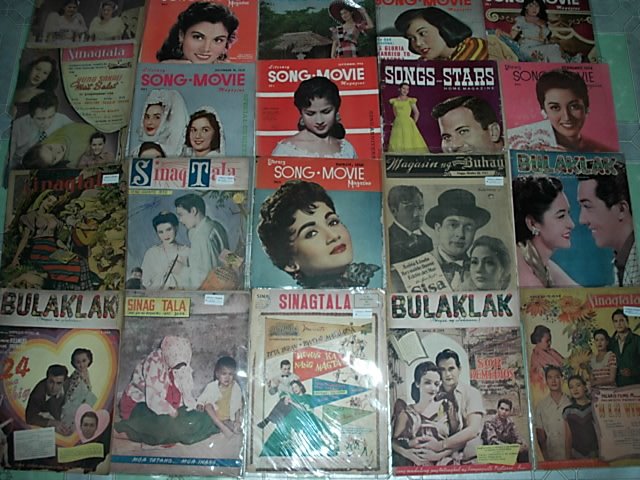
Vintage Philippine literary and movie magazines are rich references for identifying komiks serials that had been made into the movies.
I am very fortunate to acquire a good number of these old magazines from the 1920s to the 1950s, a rich minefield of information about our rich comics and movie heritage. Reading these vintage magazines provides me with the feeling of travelling through a Time Machine wherin I could get a glimpse of the olden days even decades before I was born.

My project on "Komiks and the Movies" is really getting exciting as I unearth more rare materials long since been considered extinct. As a komiks and magazine collector, I know how difficult it is to find these materials. Yet, through the years, I have not stopped hunting them in antique shops, Ebay auctions, flea markets, etc. Right now, I have more than 2,000 pieces of old Tagalog komiks and original comic art, and some 300 vintage magazines/songhits.

To my knowledge, there is no existing komiks library or gallery of comics and original comic art in the Philippines, or indeed anywhere else in the world. The National Library formerly has a good number of bound tomes of old komiks donated to them by Lope K. Santos, but all of these(save a two or three tomes) have mysteriously disappeared from their shelves.
The remaining two or three tomes are either in bad condition or very bad condition, with several pages torn or missing. It seemed that librarians have a discrimination towards comics, and they tend to treat it as reading materials "without research value". I found otherwise, reading komiks gives me a profound and unique look on Philippine culture I would not normally find on some boring textbooks.

Anyway, here are some more new finds for my project "komiks and the Movies". I will only concentrate on the Golden years of Philippine comics which, incidentally also coincides with the Golden years of Philippine movies (roughly the years 1947-72). It seemed that the fall of the komiks industry also advresely hurt the Philippine movie industry. I hope that this humble project finds itself in a pictorial book that is currently gestating in my mind.


Goldiger by Dominador Ad Castillo and Nestor Redondo. Serialized in the Manila Klasiks 1953


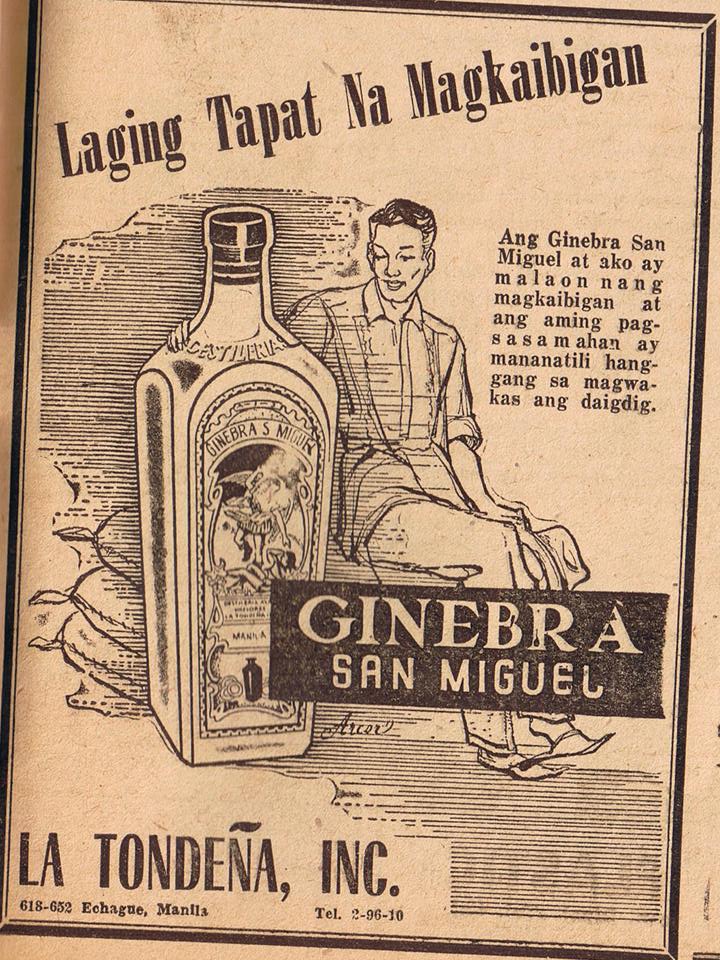
Oops, before we continue, let's give way to a little commercial from Ginebra San Miguel. The man on the ad says:"Ang Ginebra San Miguel at ako ay malaon ng magkaibigan, at ang aming pagsasamahan ay mananatili hanggang sa wakas ng panahon". Hehe Lasenggo pala ito.

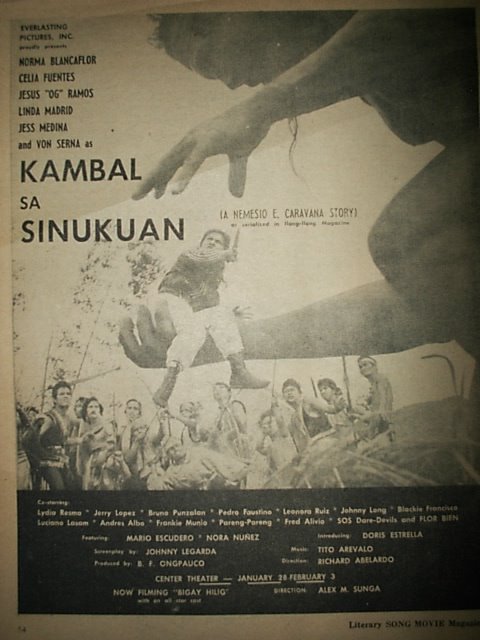
Nemesio Caravana's Kambal sa Sinukuan. Serialized in the comics section of Ilang-Ilang Magazine 1951


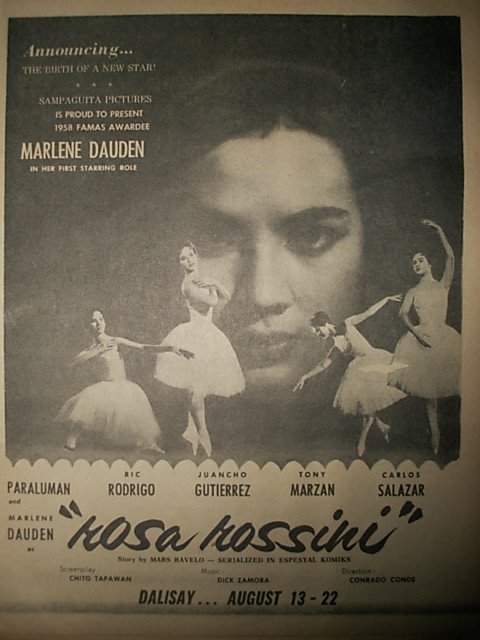
Rosa Rossini by Mars Ravelo. Serialized in the Espesyal Komiks, 1959


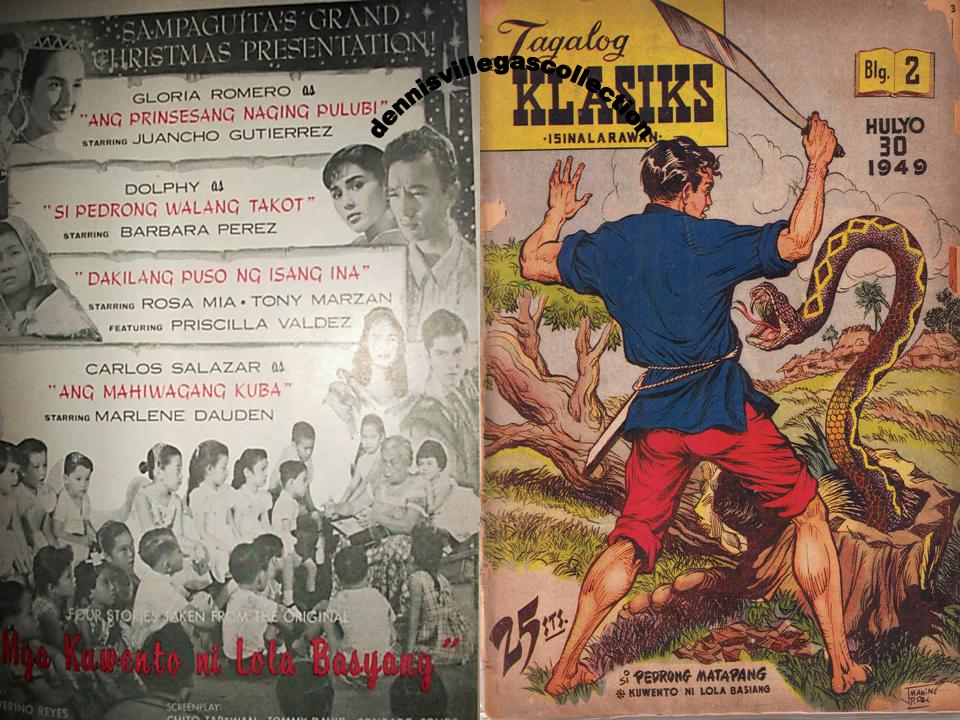
Severino Reyes' Mga Kwento ni Lola Basyang first appeared as prose fiction in the Liwayway in 1923. These wonderful stories were later adapted into comics by Severino Reyes' son, Pedrito Reyes, in the Tagalog Klasiks Komiks.


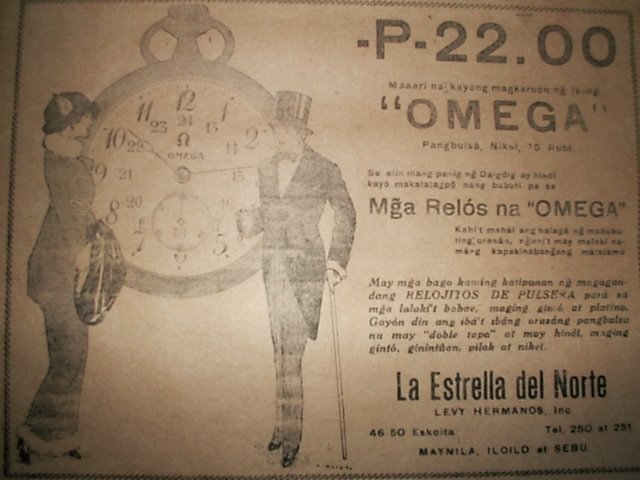
A commercial from our sponsor, Omega watches. Only 22 pesos in 1923. From the Lipang Kalabaw magazine 1923. Call La Estrella del Norte department store at tel #250 or #251. Offer is good while supplies last. Magkano kaya ang buong tindahan ng La Estrella del Norte noon, gusto ko ng bilhin e sa sobrang mura.


Tumbando Cana by Mars Ravelo. Serialized in the Tagalog Klasiks Komiks, 1956


Double-Cross by Francisco V. Coching. Serialized in the Espesyal Komiks, 1956.

Another advertisement, this time from the old reliable Alhambra Regaliz Mahaba. This cigarillo is a favorite of old women in the provinces who smoke it with the burning end inside their mouths while chewing Nga-nga or playing tong-its, hehe. Only 30 centavos per pack in 1954.

Sawa sa Lumang Simboryo by Amado Yasona and Hugo Yonzon. Serialized in the Mabuhay Komiks 1952. This movie received the first ever FAMAS Best Picture Award in 1952.


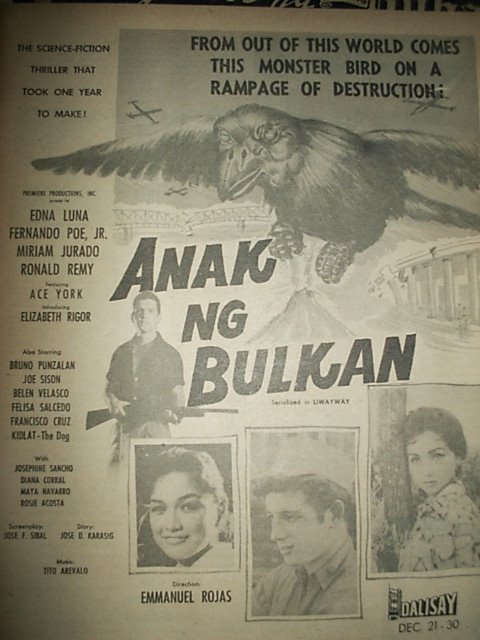
Anak ng Bulkan by Jose Domingo Karasig. Serialized in the comics section of the Liwayway, 1959. I have watched this movie several times during its reruns in Channel 5 on afternoon weekends. Starring Fernando Poe Jr. Poignant story of a little boy's friendship with a gentle giant bird. The little boy was Ace Vergel as a kid.

Tuesday, March 28, 2006

Tony Velasquez' Kalibapi Family Cartoons


During the Japanese occupation (1942-44), Tony Velasquez created a series of cartoons called “The Kalibapi Family” published weekly in the Japanese-controlled Tribune newspaper. These cartoons told the everyday life of a typical Filipino family in Manila during the Japanese occupation, and as such, should supposedly portray the new social order of the Philippines under the aegis of the Japanese Empire. The Japanese knew well the influence of cartoons on the mind of people, and they intend to utilize it to propagandize their occupation agenda.

The Kalibapi Family’s title was derived from the KALIBAPI or the Kapisanan ng Paglilingkod sa Bagong Pilipinas (Society for the service to the New Philippines), a Japanese sponsored socio-cultural-political party for serving the new Philippines under the aegis of Japan’s Greater East Asia Co-Prosperity Sphere. It was founded in November 19, 1942, under Executive Order No. 109, issued by Jorge Vargas, the Chairman of the Philippine Executive Commission. All other political parties were dissolved.

The party’s ultimate aim was to “unify the Filipinos, regardless of social class, sex, rank, or religion, in order to achieve, with the cooperation of the Japanese Military Administration, the reconstruction of the country and to reinvigorate in the people oriental values such as faith, self-reliance, respect and hard work” Source: A.V.H. Hartendorp, The Japanese Occupation of the Philippines, Bookmark, 1969

Like all others employed by the Japanese, Velasquez became member of the Kalibapi party. By 1943, there were already some 500,000 members of the Kalibapi. Source: Augusto De Viana, Kulaburetor! UST Press, 2003

The Kalibapi Family cartoons first appeared on a January 1943 issue of the Tribune. As earlier mentioned, these cartoons were supposed to be a propaganda material to serve the Japanese purposes, but Velasquez wisely managed to evade portraying it to be such.

In my readings of the Kalibapi cartoons, I have not seen anything that would make it appear as pro-Japanese or even remotely a propaganda material.


The first cartoon depicts the Japanese policy o "Philippinizing" the country, an attempt to throw away the acquired materialistic values we inhereted from the Americans. It is an attempt by the Japanese to empahsize on their propaganda "Asia for Asians, and Philippines for Filipinos"
The second cartoon show what can possibly happen if one is to hoard things to make profits in the future.

Actually, Velasquez “cheated” the Japanese Censors in this comic strip--and he got away with it. Instead of creating propaganda cartoons that portrayed the moral justification of the Japanese occupation, he portrayed the inherent qualities of the Filipino people in times of distress.

This cartoon escaped the supposedly keen eye of the Japanese military censors. By using an analogy to a captive bird, this cartoon plainly stated the Filipinos' desire for freedom. Had the Japanese noticed this, Velasquez would surely have been incarcerated in the Fort santiago.

Filipino values like pagtitiis, pagtitipid, and pagiging magalang were recurring themes in the cartoons. These, of course, did not conflict with the original aims of the Kalibapi Party, which only vaguely benefited the interests of the Japanese.

Another frequent theme in the comic strip focused on the malicious profiteering of some greedy Filipinos who took advantage of the current scarcity of basic necessities.

These two cartoon strips depicted the malicious profiteering of some Filipinos' during the hardest days of the Second World War.

It was remarkable that this strip was able to pass the approval of the Japanese censors. In fact, had it not been a time of war, the Kalibapi Family may well have passed for an educational comic strip intended for Filipino school children.

Velasquez’ fellow writers in Liwayway also tricked the Japanese. They would weave stories of heroism of Filipino guerrillas in between lines and pages that contained Japanese propaganda. Since these stories were written in Tagalog, the unwary Japanese thought they were publishing “excellent” propaganda materials.

Working for the Japanese was not particularly pleasant to Velasquez, and he still harbored hopes that the Americans would soon return to liberate the Philippines.

He admitted though that the Japanese showed some deference to him presumably because of his reputation as an artist, and not the least because of his popularity with the reading masses. For the meantime, he decided that it was best to serve the country in the best way he could, without compromising his patriotism. The complete originals of the Kalibapi Family that were published in the Japanese-controlled Tribune newspaper. Author's collection.

Saturday, March 25, 2006

Alfredo Alcala's Voltar


Whenever I gaze at the pages of Voltar, I often wonder at the sheer magnitude of Alfredo Alcala's power. I would then shake my head in utter disbelief of how an illustrator could be able to capture so dramatic a composition even the most talented photographer could fail to capture in real life.

From my conversations with several of Alcala's friends and contemporaries, I gathered that Alcala often preferred to be alone while drawing his comics. He would shut himself for several days, often with only a few hours of sleep in between, in order to create the comics masterpieces that he became famous for.

In those days, Alcala was known as the most indefatigable Filipino illustrator. He would churn out at least eighty pages of comics pages in a week's time. The quality never suffers though, as evidenced by the innumerable classic artworks that have come out from his brush and ink in almost the same time.

Alcala's classic works in Philippine comics like Voltar, Guerrero, Barracuda, Tres Ojos, Okleng, Cuatro Vidas, Kasaysayan ng Paglipad, Battleship Yamato, and so many more bore the real essence of the master's idiosyncrasies. He could put himself into any era and for sure there will be no mistake in costumes, atmosphere and ambience. The drawings are so all intricately rendered you wondered wether they were in fact, artworks of Gustave Dore's engravers.

Certainly no other Filipino artist could duplicate the great energy of Alfredo Alcala. Indeed, he is a loner, as some of his contemporaries may say, but it is because he was the only one who could do what he was able to do.

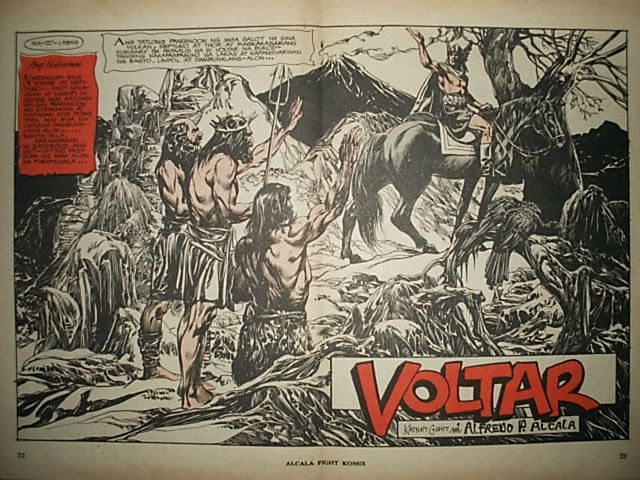
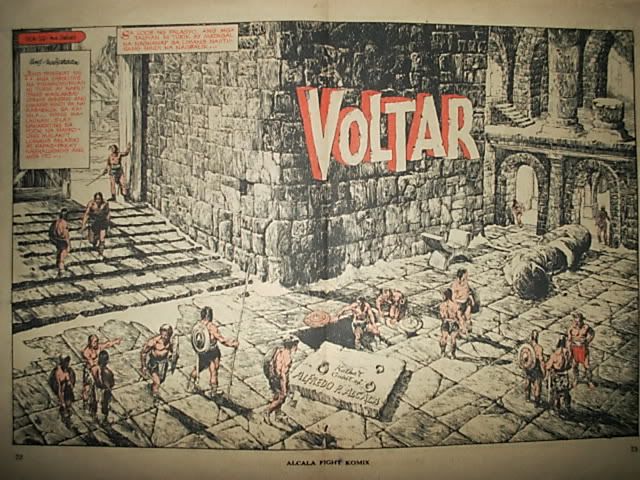
For your viewing pleasure, here are some of his immortal pages from the Voltar serialized novel that was published in his own comic book, Alcala Fight Komix in 1964. Alcala's Voltar predates Howard's Conan in comics form, and it is, according to the Comic Book Artist Magazine "one of the most magnificent adventures to have been written and drawn in comics".

I would like to thank my friend Manuel Auad of Auad Publishing for the gift of several original Alcala pages, including a very nice original Voltar page shown in the last image below. Manuel Auad is the writer of Alcala's Voltar (and the Buccaneers of the Skull Planet) that had been published by Magic Carpet in 1977. Thanks so much for your thoughtfulness, Noli!


A gift from Mr. Manuel Auad, publisher of Auad Publishing. Thanks so much Noli!

Wednesday, March 22, 2006

Komiks and the Movies Update (2)

Here are some more new finds for my pet project Komiks and Movies:


Guwapo by Carlos Gonda(Pablo S. Gomez). Serialized in Espesyal Komiks 1954.


Ifugao by Cirio H. Santiago and Alfredo Alcala. Serialized in the Hiwaga Komiks 1956.


Ooops, just a little advertisement from our dear sponsor Pepsi-Cola. Only 15 centavos per bottle in 1949. Ang Lugod ko..Mabuhay! Hehe


Pulot-Gata by Francisco V. Coching. Serialized in Pilipino Komiks 1954


Mariang Sinukuan by Narciso Asistio. Serialized in the Bulaklak 1953

Another commercial, this time from our dear sponsor Lifebuoy, the soap of the stars! 1955


Salabusab by Francisco V. Coching. Serialized in the Liwayway 1956


Jimmy Boy by Manuel Ramirez. Serialized in Pilipino Komiks 1956


Known as the "Great Profile", Leopoldo Salcedo was the King of Philippine Movies during the Golden Years of Philippine Cinema. He was also known as the Rudolph Valentino of the Philippines. Es muy guapito y simpatico.


Zafra by Conde Val Pierre. Serialized in Bulaklak Express Komiks 1958

Hagad by Amado Yasona. Serialized in the Mabuhay Komiks 1954

Time out for a little advertisement from our friendly sponsor, Cashmere Bouquet. Only 25 centavos in 1954.

Asintado by Clodualdo del Mundo and Fred Carrillo. Espesyal Komiks 1958

Vintage Magazines from the 1940s and the 1950s.